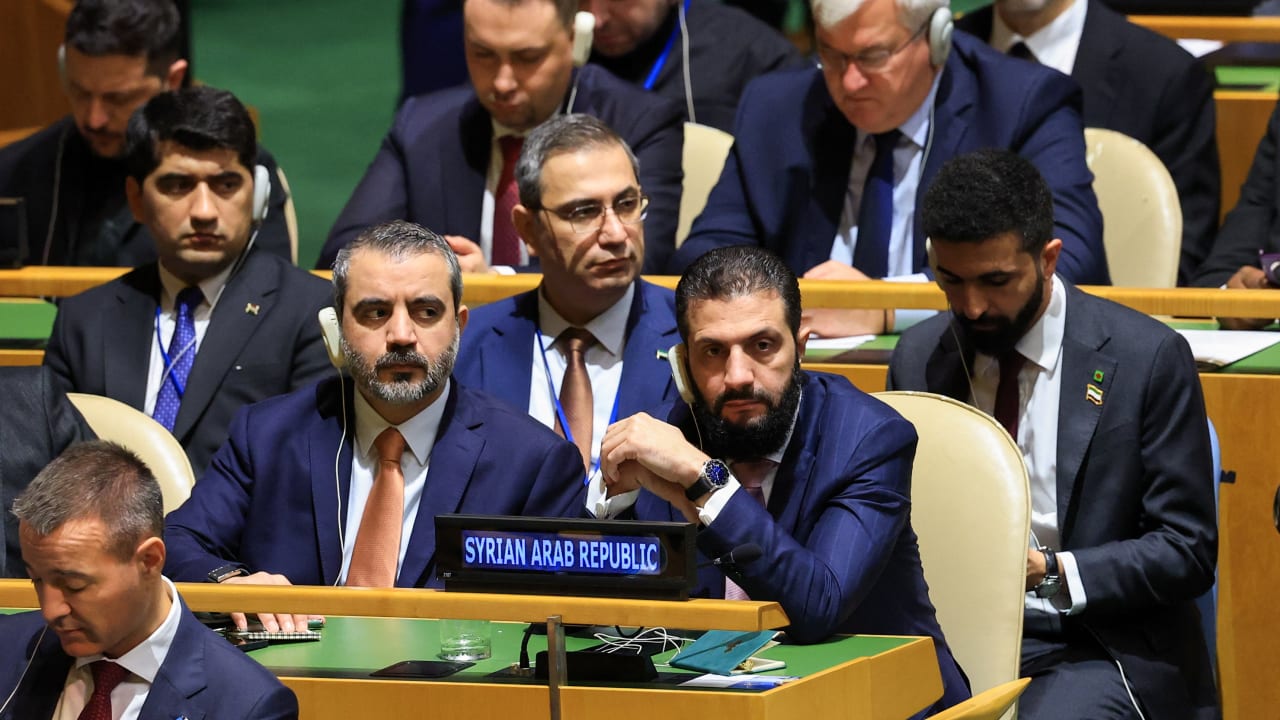
Syrian President Ahmed al-Sharaa offered one of his most extensive public assessments of Israel-Syria relations on Tuesday night, saying the October 7 massacre cannot be allowed to determine Israel's policy toward Syria and revealing that negotiations between the two countries had at one point reached "almost 90%" agreement.
Speaking at an Atlantic Council panel in New York on the sidelines of the United Nations General Assembly, Sharaa addressed direct talks with Israel, the future of the Golan Heights, Israeli security concerns, and his own controversial past in al-Qaeda.
Asked whether he understood the trauma experienced by Israeli society after October 7 and what message he had for ordinary Israelis, Sharaa said he understood what had happened to innocent civilians but argued that the attack could not serve as the basis for Israel's broader regional policy.
"I understand what happened on October 7 to some of the innocent people," he said. "But at the same time, it is not possible that all policies are set based on an incident that happened in history."
He then contrasted the attack with the death toll in Gaza, saying that more than 70,000 people had been killed there, including many women and children.

"It is not appropriate that what happened on October 7 sets the policy for Syria," Sharaa said. "This is not logical, and this brings more security threats."
"If you want to protect your own security, you need to respect the security of others."
Sharaa claims Israel's policies create more threats
Sharaa argued that Israel's current security policy was creating rather than reducing threats around it.
"Israel needs to change its policy because it is creating problems around it in order to maintain its security, and this is not working," he said, calling instead for "mutual respect and good economic and trade relations."
He also directly criticized Israeli military activity inside Syria.
"Why has Syria been bombed for two years, every day?" he asked. "There are indiscriminate arrests taking place in Syria. Even the presidential palaces have been bombed twice by the Israeli army. Our airports are being bombed, as well as all the military airports that we have. Will that bring security to the Israeli citizen?"
Pointing to Damascus's developing relations with the United States, Britain, Gulf states, Iraq, and Lebanon, Sharaa added: "Those relations are successful, and those relations are not successful with Israel. So I believe the problem is with Israel, not with Syria."
'We almost reached 90% agreement'
Sharaa also provided new details about the negotiations between Israel and Syria, saying direct talks between the sides have been taking place for roughly a year with American involvement.
"Syria chose to go through diplomacy and to solve that problem through talks and negotiations, as well as seeking the help of countries that are friendly to Israel, including the United States," he said.
"There were several sessions of negotiations with Israel, and we almost reached 90% of agreements."
Sharaa claimed that when the sides approached agreement, Israel pulled back or introduced additional conditions. He nevertheless stressed that the channel remained active.
"We are still engaging in this track," he said. "We are not saying that there will be lasting peace right now between Syria and Israel, but we need to protect the security and the rights of Syrians before we can talk about peace."
The Syrian president outlined what he described as a phased process.
Israel, he said, must first withdraw from territory it entered after the fall of Bashar al-Assad's regime on December 8, 2024, and return to the positions associated with the 1974 disengagement arrangement.
Only then, he said, could the sides move into discussions over security arrangements.
"If those arrangements succeed, then we can get into discussions about lasting peace," Sharaa said.
He acknowledged that Israel has legitimate security concerns but rejected the idea that those concerns could justify every Israeli action.
"There are concerns of Israel. We always discuss those concerns, but not everything Israel does can be justified by them," he said.
Sharaa even floated the possibility of an international committee that would assess "what is only a perception" and what constitutes a genuine Israeli security concern.
"I believe what we can achieve at this time is a historic moment that can be useful for all parties," he said.

The Golan, Trump – and New Jersey
On the Golan Heights, however, Sharaa drew a firm line.
He said Damascus regards the territory as Syrian and suggested that its ultimate ownership was not open to negotiation.
Asked about US President Donald Trump's recognition of Israeli sovereignty over the Golan Heights, Sharaa recalled joking about the issue during a White House meeting with Trump.
"President Trump stood by Syria, supported Syria, and issued a historic decision to lift sanctions off Syria, and I have a very unique relationship with him," Sharaa said.
"But once, when I visited him in the White House, I made a joke with him."
"When he said about the Golan Heights that Israel has sovereignty, I said, 'Why don't you give New Jersey to the Israelis? You don't own the Golan Heights to give it to them, but you own New Jersey, and I believe New Jersey is full of Democrats, and they are not voting for Trump. So it will be good to give it to the Israelis.'"
"At least this is something that you own," he continued. "President Trump doesn't own the Golan Heights."
Sharaa then turned serious.
"Regardless of this joke, the Golan Heights belong to their own people," he said. "It is neither the Syrian president nor the American president nor any other person who can abandon them or give them up to others."
'The state should be an institution, not an individual'
Beyond Israel, Sharaa sought to portray a changing Syria following the collapse of the Assad regime.
He said Syria's transitional period is intended to lead toward a new constitution and a system in which authority is vested in institutions rather than in a single ruler.
"What we are trying to instill now in Syria is respect for the law," he said, "in order to make sure that authority is an institution and not an individual that is ruling the country."
He also said cultural and linguistic rights granted to Syria's Kurdish population would ultimately be incorporated into the constitution.
On foreign military forces, Sharaa said his long-term objective was a Syria without foreign military bases. He claimed Russia's military footprint had already been reduced dramatically and said negotiations were continuing over the status of its remaining presence.
Al-Qaeda past and September 11
The discussion also returned to the most controversial chapter of Sharaa's past.
The moderator noted that in 2013, when Sharaa was known as Abu Mohammed al-Jolani and led the Nusra Front, he pledged allegiance to al-Qaeda leader Ayman al-Zawahiri, and asked whether he now explicitly renounced both that pledge and the ideology behind it.
Sharaa did not offer a direct renunciation in response.
"There are so many questions that are part of the past now, so maybe we need to update ourselves," he said. "I answered this question so many times before."
"I don't believe that it is appropriate to discuss things that happened 25 years ago. I was at a different age, and the conditions in the region were different," he added, arguing that his views evolved through the Syrian conflict and the struggle against the Assad regime.
Asked specifically about the September 11 attacks, however, Sharaa was unequivocal.
"I had nothing to do with that," he said. "At the time, I was 13 years old. I didn't know anything about this stuff."
"Of course, I am sorry for all the victims who perished in the United States, or those who fell in the Middle East because of the policies that were pursued there that victimized a lot of people."
"For sure, we are completely disengaged from what happened then and that act that took place in New York."