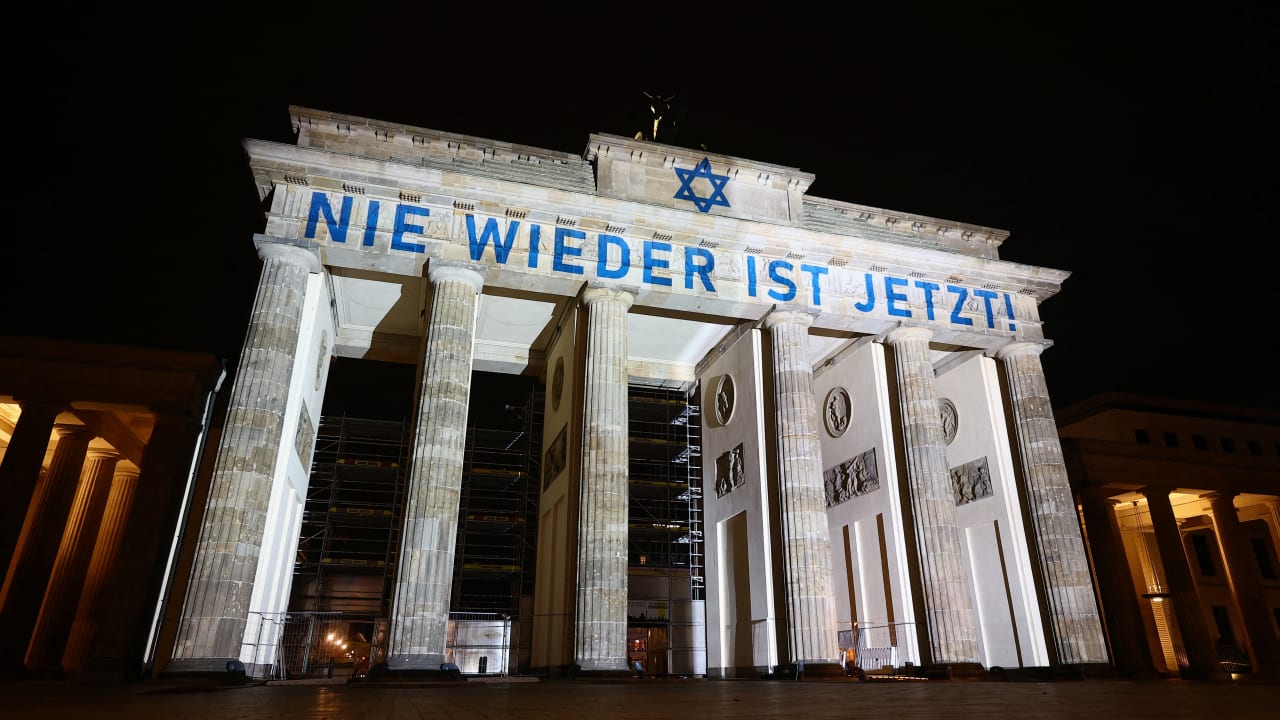
The memory of six million murdered Jews has become part of Germany's national identity. Yet the solemn promise of “Never again” is all too often followed by the familiar words “We strongly condemn.”
In August, I traveled to Rottleberode, a small village in Saxony-Anhalt, to research the story of my husband's great-uncle, a Holocaust survivor. On one side of the street stood a memorial stone marking the presumed site of a subcamp of the Mittelbau-Dora concentration camp. On the other, directly across from the memorial, swastikas had been scrawled across election posters. You couldn't make it up.
On November 9, Germany once again commemorates the pogroms of 1938. Politicians deliver speeches, lay wreaths, and promise to fight antisemitism. In less than three months, on January 27, the ritual will be repeated on the anniversary of the liberation of Auschwitz.
Of course, Germans do not remember the Holocaust only twice a year. There are archives, memorial sites, and research centers. Schoolchildren visit former concentration camps, and civic organizations run educational programs. The country that murdered six million Jews can now take pride in how exemplary its remembrance of them has become.
German-Jewish writer Max Czollek has long criticized this approach. He calls it Versöhnungstheater – the theatre of reconciliation. In this performance, Jews are cast in a supporting role in Germany's story of its own moral redemption.
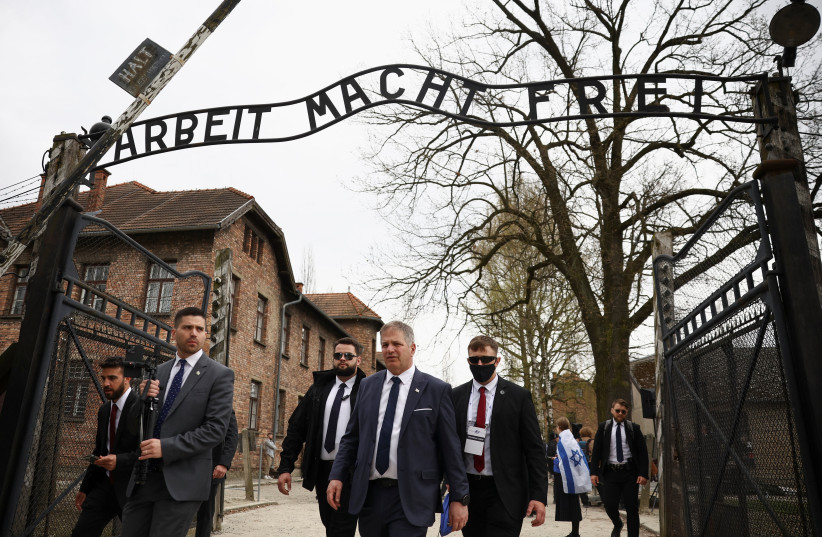
Dead Jews are 'more convenient' than those who are alive
Germany acknowledges its guilt, Jews take part in the ceremonies, and the audience receives yet another reassurance that the country has learned how to deal with its past.
Even in the way the history of the Holocaust is presented, Jews are often portrayed primarily as passive victims rather than people who fought back. Jewish resistance, partisan movements, and underground Zionist organizations have received far less attention outside Israel.
Dead Jews, it turns out, are far more convenient than living ones. They don't argue with the organizers of remembrance ceremonies. They don't criticize politicians. They don't insist on having a say in debates about Israel, antisemitism, or remembrance itself. They fit neatly into any commemorative script.
Living Jews are more complicated. They have opinions, political convictions, and interests of their own. Yet public curiosity about Jewish life is also remarkably superficial. Otherwise, Germans wouldn’t be asking a random Jew a few times a year whether he’s allowed to drink alcohol.
It is particularly striking how much faith Germany places in the educational power of its remembrance culture, despite the surprisingly limited systematic evidence on the effectiveness of many educational programs.
In January 2026, researchers Jannis Niedick, Linda P. Juang, and Leo Bitter published a review of research on educational initiatives aimed at combating antisemitism. Of the thousands of publications screened, only six met the criteria for inclusion as empirical evaluations. Five concerned Germany, and none of those five had undergone peer review.
The review did not cover all Holocaust education. Still, for a country that has invested so heavily in education as a means of combating antisemitism, the lack of rigorous evaluation should raise uncomfortable questions.
Instead, success is often measured by the number of memorial visitors, school trips, and seminars held.
A student visited Auschwitz. Check.
A class took part in an antisemitism awareness project. Another check.
A ministry funded a new initiative. Wonderful.
But did any of it change what participants actually believed? Did they learn to recognize antisemitic stereotypes? To distinguish criticism of the Israeli government from holding Jews and Israelis collectively responsible? To spot old conspiracy theories dressed up in contemporary political rhetoric?
Knowing about the Holocaust does not automatically answer these questions. Someone can acknowledge the existence of gas chambers and still believe in a Jewish conspiracy. And the contradictions become even harder to ignore when remembrance moves from museums and classrooms into everyday politics.
Need to combat antisemitism
In 2017, Björn Höcke, one of the most prominent figures in the Alternative for Germany (AfD), called for a 180-degree reversal in Germany's remembrance policy. He advocates for the so-called “Schlussstrich” – “drawing a line under the past” – which means putting an end to the memory of Nazi crimes. Supporters of this idea seek to shed historical guilt to forge a new national identity, while critics see it as a threat to democracy. Today, the AfD is a major parliamentary force, while its representatives invoke antisemitism in sweeping anti-immigration rhetoric.
But these contradictions are hardly confined to the AfD. In September, the city council of Heidenau, Saxony, voted to prohibit the installation of new Stolpersteine – stumbling stones commemorating victims of Nazi persecution – on public streets and sidewalks. Representatives of the Christian Democratic Union (CDU) and the AfD proposed the measure.
The political left has its own contradictions. Shortly before the Berlin elections, a rapper performed a song featuring the words “Death to the IDF” at an event organized by the Neukölln branch of the Left Party (Die Linke). And at the branch's post-election celebration, an activist linked to the Popular Front for the Liberation of Palestine (PFLP), an EU-designated terrorist organization, made an appearance.
When politicians speak of the need to combat antisemitism, I would rather hear answers to some more practical questions than yet another “Never again”. What prompted the local CDU to support the decision in Heidenau? Why was a reportedly PFLP-linked activist at the Left Party’s election party? How do the authorities measure the effectiveness of the programs they fund?
And that is what makes November 9 so infuriating. Politicians from across the political spectrum will once again invoke Germany's historical responsibility. Saying “Never again” is easier than confronting present problems. By evening, they will have posted their photographs from remembrance ceremonies. Antisemitism will have been strongly condemned.
Then comes November 10. Society can relax until January 27.