The Houthis are continuing their war against the Yemeni government, and the Saudis are confronting them. At the same time, Gulf Cooperation Council (GCC) defense ministers have agreed to establish a forward military command in Kuwait as regional tensions intensify amid renewed fighting in Yemen, Iranian threats to maritime shipping, and ongoing Houthi attacks on Saudi Arabia.
The GCC is strengthening and learning lessons from nine months of conflict. The Iranian-backed Houthis in Yemen reported a series of Saudi military attacks on Wednesday, including airstrikes in Taiz and Lahj provinces, artillery shelling along the Saudi-Yemen border, and an attempted incursion into airspace over the capital, Sanaa, by Saudi F-15 fighter jets.
The claims were published by the Houthi-affiliated Al-Masirah media network, which described the incidents as part of a renewed Saudi military escalation. While some of this may be Houthi propaganda, it’s important to understand how they perceive what is happening.
The Houthis have been on the offensive in recent months, but they also suffered setbacks. They are currently laying siege to the city of Taiz. They also say civilians have been killed in the fighting in Saadah Province.
Yemen’s Houthi-run Health and Environment Ministry spokesperson, Dr. Anis al-Asbahi, said civilians were wounded in the Jubbanah area of Razeh district. A fourth civilian was reportedly wounded in an attack on the center of Qatabir District.
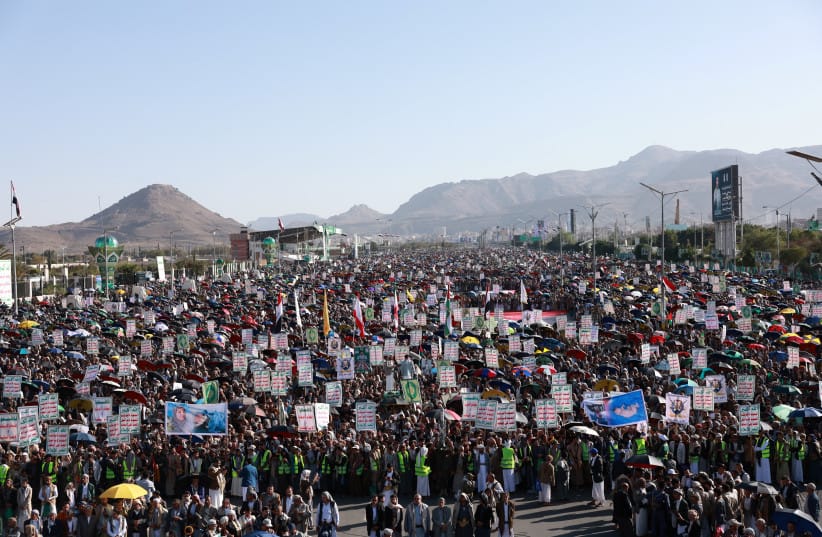
Houthis claim air defenses detected Saudi fighter jets entering Sanaa airspace
There was Saudi artillery shelling in the border district of Shada, Al-Masirah reported.
In a separate development, the Houthis said their air-defense systems had detected a formation of Saudi F-15 fighter jets attempting to enter airspace over Sanaa.
Houthi air defenses were used against the Saudi aircraft, Houthi military spokesperson Brig.-Gen. Yahya Saree said.
The Houthis say they have developed air defenses with the backing of Iran over the past decade, and that Saudi Arabia has resumed air operations against areas under their control.
Saudi warplanes conducted several airstrikes late Tuesday night in al-Shamayatayn district in Taiz Province and Al Maqatirah District in neighboring Lahj Province, Al-Masirah reported. According to a security source cited by the network, one strike targeted the Barh al-Dhahr area in Taiz, while another hit al-Ma’in area in Lahj.
The strikes followed additional attacks earlier in the evening, Al-Masirah reported.
The Houthis portrayed the reported incidents as an expansion of Saudi military operations, involving both border shelling and airstrikes farther south.
GCC ministers agree to establish forward military command in Kuwait
GCC defense ministers have agreed to establish a forward military command in Kuwait as regional tensions intensify amid renewed fighting in Yemen, Iranian threats to maritime shipping, and ongoing Houthi attacks on Saudi Arabia.
This reflects lessons learned from nine months of conflict.
The decision was announced on Tuesday by GCC Secretary-General Jasem Mohamed AlBudaiwi, following the 23rd session of the GCC Joint Defense Council in Bahrain, Saudi Arabia-based newspaper Arab News reported.
The new headquarters will operate under the GCC Unified Military Command and have military forces assigned, the report said.
THE DECISION follows an extraordinary GCC summit in Jeddah in April that called for greater military coordination in response to common threats.
AlBudaiwi condemned Iranian attacks on Gulf states and Houthi attacks on Saudi Arabia, adding that “the security of the kingdom is an integral part of the security of all GCC countries.”
The announcement came as Yemen’s internationally recognized government reported a major military offensive against the Houthis.
Yemeni government military spokesperson Majed al-Nuzaili said government-aligned forces had conducted 874 attacks against Houthi targets over several hours as part of Operation Dawn of Yemen, Arab News reported.
The military said about 190 Houthi fighters and commanders had been killed or wounded, while some 130 military vehicles and other pieces of equipment were destroyed or damaged, the report said.
The operations included 29 airstrikes, 39 drone strikes, 62 rocket-launcher missions, and 744 artillery missions, it said.
Government-aligned forces, including the Nation’s Shield Forces, Giants Brigades, and National Resistance, also claimed territorial gains on southern and southwestern fronts. Fighting continued in Marib, al-Jawf, Taiz, and other areas.
Elsewhere, Iran said an oil tanker had hit a mine and caught fire in the Strait of Hormuz on Wednesday.
The UK Maritime Trade Operations agency separately reported a tanker incident but could not confirm the crew’s condition or the extent of the damage.
The incidents illustrate continuing threats to shipping through the strategic waterway, which carries about one-fifth of global oil supplies.
The US has been escorting vessels through Hormuz while maintaining a naval blockade on Iranian ports.
Diplomatic efforts are also continuing. Saudi Foreign Minister Prince Faisal bin Farhan met representatives of Qatar, France, Germany, Italy, and the United Kingdom on the sidelines of the G7 foreign ministers’ meeting in Paris.
Participants discussed Houthi attacks on civilian infrastructure, efforts to reduce US-Iran tensions, and the importance of protecting maritime trade routes, the Saudi Press Agency reported.
Together, the developments illustrate how Yemen and the Gulf are connected and face common security challenges. Iran views this as one long front line of 4,800 km.
Meanwhile, the US is moving to shore up its diplomatic footprint in the Gulf.
“President Donald Trump’s nominee to become the next US ambassador to Saudi Arabia, Wesley Hunt, pledged Tuesday to deepen Washington’s strategic partnership with Riyadh while defending the administration’s approach to civilian nuclear cooperation with the kingdom,” Saudi Arabian news channel Al Arabiya reported.
Hunt was nominated in September.
“Speaking before the Senate Foreign Relations Committee, Hunt described Saudi Arabia as a cornerstone of US security and economic interests in the Middle East, highlighting opportunities to strengthen defense cooperation, expand trade, and investment, and advance regional stability,” the report said.
UAE-based newspaper The National reported: “US President Donald Trump has nominated former Kansas governor Jeffrey Colyer to be the American ambassador to the UAE.”
“The UAE has been without a US ambassador since Martina Strong left in August 2025,” the report said. “The Trump administration has been slow to appoint envoys to key posts, including in the Middle East. Saudi Arabia, Qatar, Kuwait, and Iraq remain without confirmed US ambassadors.”
On Monday, the White House said it had nominated “Matthew Millhollin, of Tennessee, to be ambassador extraordinary and plenipotentiary of the United States of America to the Sultanate of Oman.”