
There are books that tell the author’s story, even subliminally, regardless of whether or not the writer themselves is the declared autobiographical subject. Any artist, including when the principal thematic anchor is of a non-fictional nature, must, to some greater or lesser degree, bring something of their own baggage to the creative plate. That could be of the cerebrally-leaning variety or the more heartfelt kind. In Rivka Regev’s case, that goes double, treble, a hundredfold, particularly with regard to the latter.
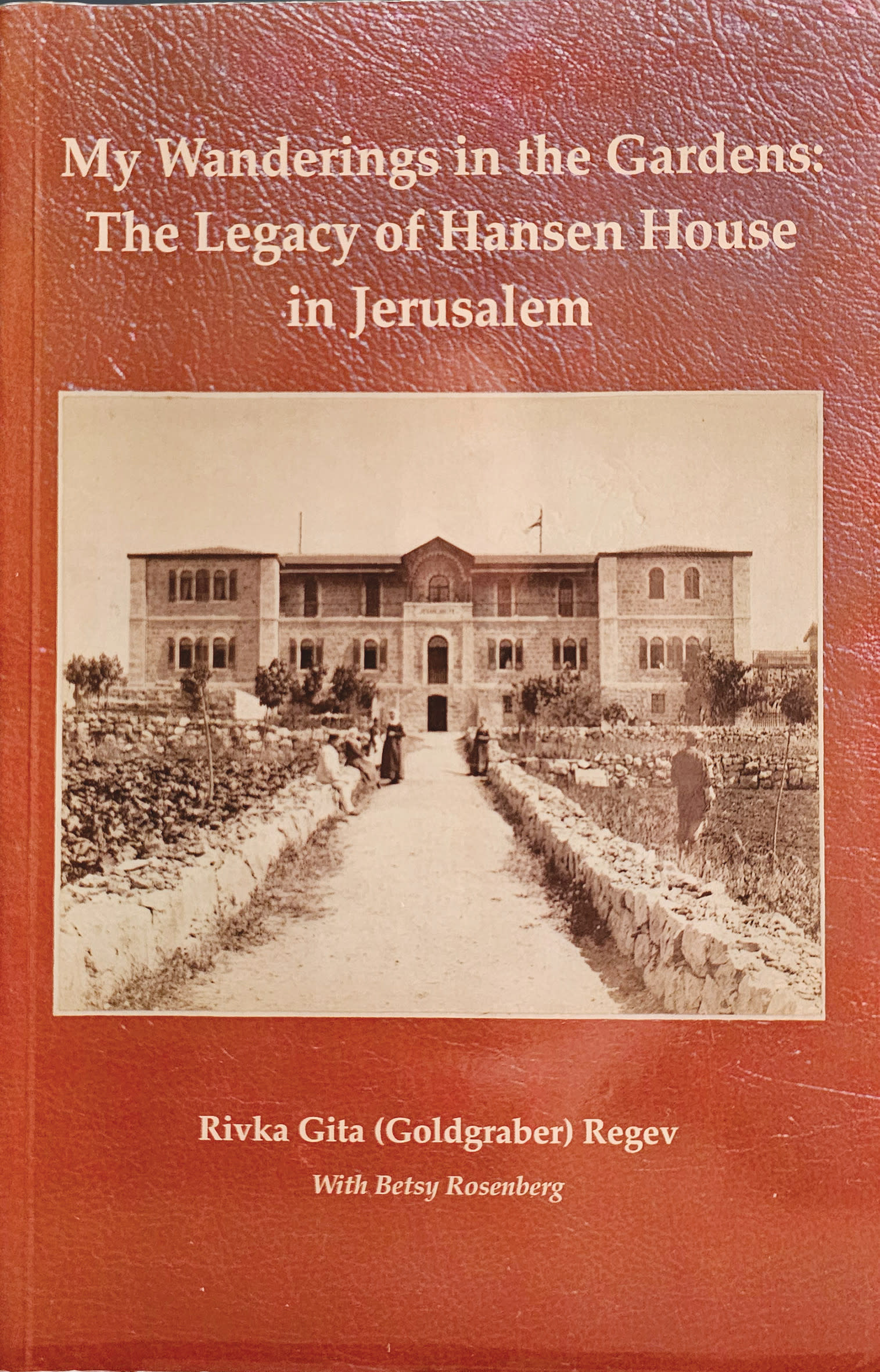
My Wanderings in the Gardens: The Legacy of Hansen House in Jerusalem is a charming, arresting, evocative, historical, information-laden portrayal of the backdrop to the architectural and cultural gem in the Talbieh neighborhood. Regev certainly put in the spadework along with Betsy Rosenberg, seeking out documents, traveling abroad to obtain information firsthand from people who knew the former hospital from personal experience, as well as from archives. But this isn’t just a professional job clinically well executed by the project initiator. Regev knows Hansen House like the back of her hand. She has an insider, ground-level knowledge of the building as it was long before it reemerged as a cultural center after years of neglect.
The now septuagenarian Regev lived there when she was in her teens, when the institution was officially called The Hansen Government Hospital.
Her father, Dr. Moshe Beer Goldgraber, served as the last in-house doctor there after the family returned from a 10-year sojourn in Chicago. Regev and her parents were duly ensconced in the 19th century edifice surrounded by sprawling gardens and agricultural land, closed off from the expanding western part of the city by sturdy high walls. Hence Regev’s English is mother-tongue proficiency level and, indeed, her preferred form of spoken communication.
Regev’s account of the goings-on at Hansen Hospital
Having spent a chunk of her early formative years there, Regev’s account of the goings-on at Hansen Hospital – aka Jesus Hilfe – is infused with an intimacy and undisguised passion you don’t generally get from even the best of documentary writers, even if they have conducted the most thorough research preliminaries and are blessed with a flowing literary style.
Regev did a good job in the writing department herself. That comes as a surprise considering her professional training was in the field of social work. But My Wanderings in the Gardens is truly a labor of love.
There is so much to dig into across the close to 300 pages, with the copious text in a relatively small font betwixt photographs from across the ages, from the 19th century through to the present day. In terms of ease of pure perusal, the handbook-proportioned tome might have been better off had it been produced in something closer to coffee table dimensions. Then again, this is hardly an intentionally showy effort that begs to be flipped through, admired for its voluptuous looks and then returned to its repose as a living room centerpiece.
A book that begs to be read properly,
This is a book that begs to be read properly, across time. It is not just about Regev’s umbilical cord bond with the stately edifice and its expansive grounds. In it we learn about the storied history of the institution and of the various colorful characters that peopled it over the decades.
We read about some of the history of Jerusalem as it grew periodically, in spurts and in leaps and bounds, through Ottoman rule, the British Mandate, and then the young Jewish state. Regev charts, for example, the timeline of the water sources and supply to the capital, which leads seamlessly to Hansen House’s own cistern infrastructure.
We acquire insight into leprosy, aka Hansen’s disease, the ailment that gave the place its name, and are enlightened about the sufferers and the social estrangement they endured, which included blatant discrimination, according to Regev.
The aptly named My Wanderings in the Gardens takes the reader by the hand and walks them along the flagstone-floored corridors and through the rooms with their vaulted ceilings, and out into the sprawling grounds where wheat, grapes, and figs grew in abundance, in a cloistered urban oasis.
Regev’s parents, Moshe and Dvora, also have their place in the book, which, considering their contribution to the latter stages of the then-hospital, and the author’s symbiotic link with the place, makes perfect sense and adds to the end product.
The epilogue fittingly sets the institution, in its current guise as a cultural center and social hub, in the context of post-October 7 Israel. She closes her literary account of her beloved former home with the sunny belief that, recalling “the bravery of the many residents of Jesus Hilfe… the people of Israel – Jews, Christians, and Moslems and all people with belief in the sanctity of life – will thrive and support each other in the future.”
That’s a thought to hold and ponder any time we may visit Hansen House, and in our everyday lives beyond its venerable walls. ■
For more information: www.hansenhousejerusalembook.com/
MY WANDERINGS IN THE GARDENS: THE LEGACY OF HANSEN HOUSE IN JERUSALEM
By Rivka Gita (Goldgraber) Regev With Betsy Rosenberg
Hansen House
280 pages; NIS 40