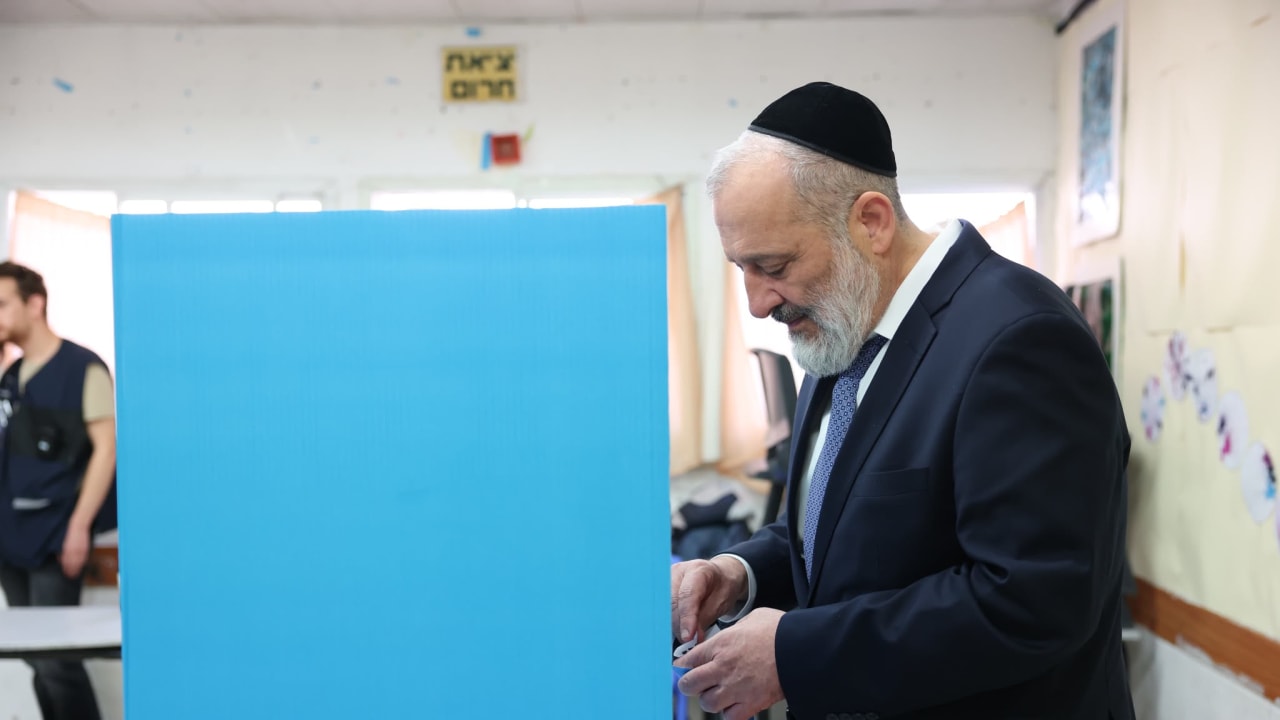
Shas chairman Arye Deri has ruled out joining a government led by the opposition bloc without Likud, while United Torah Judaism (UTJ) is emerging as a potential coalition partner, ultra-Orthodox sources familiar with negotiations to form the next government said, following Tuesday's elections for the 26th Knesset.
The sources pointed to a fundamental difference between the two ultra-Orthodox parties' approaches. While UTJ is emerging as a possible negotiating partner for the opposition bloc's leaders, Shas has made clear it does not intend to join such a government without Likud.
According to the sources, Deri made clear in closed-door discussions that he is unwilling to join an Eisenkot-led government. The position comes as the ultra-Orthodox parties' coalition choices have become central to efforts to form the next government.
"The Oslo Accords were enough for him," they said. "He is not prepared for Shas to sit with the Left again and bear the public cost of such a move. As far as he is concerned, if a right-wing government cannot be formed, Shas would be prepared to participate in a unity government, but only together with Likud."
The divide between the two ultra-Orthodox parties has taken on particular significance in light of the 26th Knesset election results, which left neither bloc with the 61 seats needed for a parliamentary majority.

Despite Shas's refusal, Maran Rosh Yeshiva Rabbi Dov Landau urged MKs from Degel Hatorah to consider joining the opposition bloc in coalition, Ishay Coen reported on Friday morning.
"We are not in anyone's bloc," Landau said. "We are in the bloc of the Torah world."
"Make every effort to regulate the status of yeshiva students."
Coalition arithmetic leaves both blocs short of a majority
According to the election results, Netanyahu's bloc holds 53 seats, the opposition bloc has 48, and the Arab parties hold 19.
The three main parties in the opposition bloc, Yashar, B'Yachad, and the Democrats, hold a combined 41 seats. Adding UTJ, which has seven seats, to the emerging coalition would bring it to 48 seats, 13 short of the required 61-seat majority.
Adding both ultra-Orthodox parties to the three opposition bloc parties would bring their combined strength to 54 seats, seven short of a majority.
By contrast, bringing both ultra-Orthodox parties into the entire opposition bloc, including Yisrael Beytenu, would produce exactly 61 seats.
However, given Avigdor Liberman's opposition to joining a coalition with the ultra-Orthodox parties and Deri's stated opposition to an Eisenkot-led government without Likud, this remains, at this stage, a purely mathematical possibility.
Another option is a minority government relying on outside support from Arab parties. Discussions over an Eisenkot-led government have also included the possibility of including Ra'am.
For example, the three opposition bloc parties, together with UTJ and Ra'am, would hold 56 seats. Additional support from the Joint List would raise that figure to 67, although such a move would require significant political agreements among parties with differing positions.
Nevertheless, forming a government does not necessarily require the support of 61 Knesset members in a confidence vote. A simple majority of those voting in favor over those voting against is sufficient.
For example, a government supported by 56 Knesset members could be formed if the Joint List's 11 lawmakers abstained and all 53 remaining MKs voted against it. In that scenario, the confidence vote would pass by 56 votes to 53.
By contrast, a government consisting solely of the three opposition bloc parties and UTJ, with 48 seats, would require at least 25 additional MKs to abstain or be absent from the vote, assuming all other lawmakers voted against it.
Netanyahu's bloc, which holds 53 seats, also needs eight additional mandates to reach a 61-seat majority. Numerically, that is exactly the number of seats held by Ra'am.
Military conscription law remains a major obstacle
On disagreements over the military conscription law, ultra-Orthodox sources expressed cautious optimism about reaching agreements with the opposition bloc's leaders, while stressing that the outcome would depend on their willingness to compromise. The issue has also sparked internal debate within Shas following the election.
"If replacing the government and removing Netanyahu, Ben-Gvir, and Smotrich from power are at the top of Eisenkot and his partners' priorities, we assume it will be possible to find common ground on the conscription issue," the sources said.
"If not, they will not have a government. They will have to decide what matters more to them and what they are prepared to give up to achieve it."
Thus, while UTJ is emerging as a potential negotiating partner, Shas's position narrows the options for forming a new government without Likud.
Even an agreement with UTJ on military conscription would not, by itself, be enough to form a government. The opposition bloc's leaders would still have to secure additional support or reach agreements that would allow the government to win a confidence vote.