
Prime Minister Benjamin Netanyahu’s bloc maintained its lead after the final vote count from Tuesday’s election with 53 seats in the next Knesset, the Central Elections Committee reported Thursday. The opposition bloc won 48, it said.
Both blocs fell short of the 61 seats needed for a Knesset majority. The Arab parties won a record total of 19 seats.
The official vote count was announced amid a Shin Bet (Israel Security Agency) investigation into suspicions that foreign entities, potentially including Qatar and Turkey, funneled money into Israel to influence voter turnout in the Arab sector.
Central Elections Committee chairman Justice Noam Sohlberg directed Shin Bet Director David Zini to investigate the suspected foreign funding and election interference.
The integrity of the vote at polling stations had been maintained, the Central Elections Committee said.
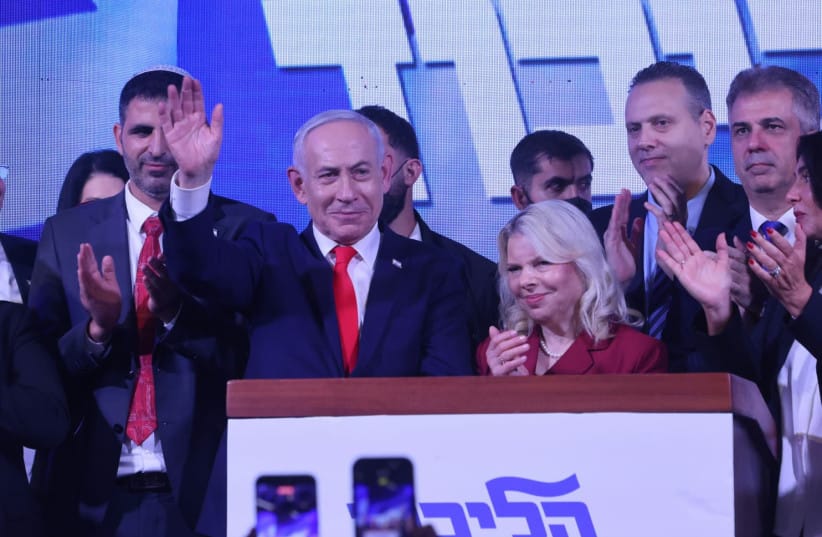
The official vote count announced on Thursday included the remaining double-envelope ballots, which were the last to be counted.
How many seats does each party have?
Netanyahu’s Likud is projected to enter with 27 seats, making it once again the largest party in the Knesset. United Torah Judaism and Otzma Yehudit are expected to enter with seven seats, and the Religious Zionist Party and Shas are expected to enter with six seats.
Most TV channel polls before the elections showed Likud receiving significantly fewer seats, while other parties in Netanyahu’s bloc, including Shas and Otzma Yehudit, were projected to gain more.
The opposition bloc, comprising Yashar, B’Yachad, Yisrael Beytenu, and The Democrats, is expected to enter the Knesset with 48 seats.
Gadi Eisenkot’s Yashar is projected to enter the Knesset with 21 seats. B’Yachad, led by Naftali Bennett, is expected to enter with 12 seats. Yair Golan’s The Democrats is expected to enter the Knesset with eight seats. Avigdor Liberman’s Yisrael Beytenu is expected to enter with seven.
The Joint List was projected to win 11 seats, while Ra’am was projected to secure eight seats in the next Knesset.
Most TV channel polling before the elections had shown the opposition bloc in the lead, and Yashar was projected to be the largest party in the Knesset.
Ofer Winter’s People of Israel party and Yoaz Hendel’s The Reservists-Economic party both fell short of the required 3.25% threshold.
The prospect of a unity government involving Netanyahu and Eisenkot remains possible, although Eisenkot had previously rejected serving under Netanyahu, including in a rotation government. Other opposition leaders have also ruled out joining a coalition led by Netanyahu.
The political deadlock could also ultimately lead to another election, although the parties may still reach an agreement through coalition negotiations.
By law, the president is required to consult the Knesset factions before deciding who receives the task of forming a government.
President Isaac Herzog on Wednesday called on political leaders to approach coalition negotiations with open minds, warning that Israel must do everything possible to avoid another round.
He also called for a full investigation into the Qatari election interference allegations on Thursday amid the Shin Bet investigation and warned against the threat of delegitimizing the voting process.
Golan met with Ra’am chairman Mansour Abbas and has called for the opposition bloc to form a government with the Arab parties. He also held separate meetings with Eisenkot and opposition leader Yair Lapid on Thursday.
Eisenkot and Bennett met on Thursday and said they had discussed forming a new government as quickly as possible.
Meanwhile, Liberman reiterated on Thursday that he would not sit with the Arab parties or Netanyahu, following reports that he was ignoring phone calls from his fellow opposition members.
“The only coalition we would consider is one made up exclusively of Zionist parties, including Likud without Bibi [Netanyahu],” Liberman said.
All other opposition party leaders except Golan had drawn a redline to Arab parties being part of the government, saying they are not viable coalition partners after the October 7 massacre in 2023.
Eisenkot has called for the leader of the largest party in the opposition bloc to become its candidate for prime minister, although no agreement on the arrangement has been announced within the bloc.
The political deadlock also raised the possibility of a minority government being formed that could win a Knesset confidence vote without holding an absolute majority of 61 seats. In that scenario, Arab parties could agree to support the opposition bloc. Members of the Arab parties have called to do whatever is possible to prevent Netanyahu from remaining in office.
Objections within the opposition bloc to relying on Arab parties could complicate such an arrangement. Liberman had openly rejected such an option ahead of the elections.
The recent Shin Bet investigation into Qatari influence in the elections could also reduce the likelihood of such a situation.
The investigation prompted Netanyahu’s Likud to demand that no Zionist party “cooperate with Ra’am and the Joint List.”
The Likud also demanded “immediate action, using all the means at the disposal of the Shin Bet and the police, to investigate these crimes.”
Likud had separately accused the Arab parties of allegedly stealing the election through widespread electoral fraud, bribery, intimidation, and ballot manipulation. It demanded an immediate investigation by law-enforcement authorities.
All opposition party leaders called on the Shin Bet and Sohlberg to conduct a full and thorough investigation into Qatari influence in the elections.
Eisenkot said he was in contact with the relevant authorities and warned against political actors exploiting the situation to influence the swearing-in date of the 26th Knesset.
He later accused Netanyahu of launching an organized campaign to delegitimize Tuesday’s election results and vowed to prevent any delay in the new Knesset’s swearing-in.
Abbas said he welcomed the decision to investigate, adding that his party was not involved in any way.
Shir Perets and Jerusalem Post staff contributed to this report.