
The gap between Israel's coalition and opposition blocs has widened to six seats ahead of Tuesday's Knesset election, despite the two largest parties being separated by just two seats, according to a Maariv poll by Lazar Research published Friday.
The coalition bloc receives just 48 seats this week, following the failure of Ofer Winter's People of Israel party to cross the electoral threshold. The party receives 3% of the vote, below the required 3.25%. Meanwhile, the opposition's change bloc has strengthened to 54 seats. Recent polling averages have shown the two political blocs nearly tied, highlighting the fluctuations in the election race.
The poll also shows that United Torah Judaism and Otzma Yehudit each lost one seat, polling 7 mandates, while Likud (19), Shas (8), and the Religious Zionist Party (7) each gained one. Overall, the coalition bloc has weakened by three seats compared with the previous week's poll.
Within the opposition bloc, the most significant change is the two-seat jump by Naftali Bennett's B'Yachad party, which rises to 15 seats. The Democrats also gained one seat this week, reaching 10. In contrast, Gadi Eisenkot's Yashar party (21) and Yisrael Beytenu (8) remain unchanged. Other election surveys published on Wednesday also placed Eisenkot's party ahead of Likud.
The poll also shows that the Reservists or the New Economic Party narrowly crosses the electoral threshold, winning four seats.
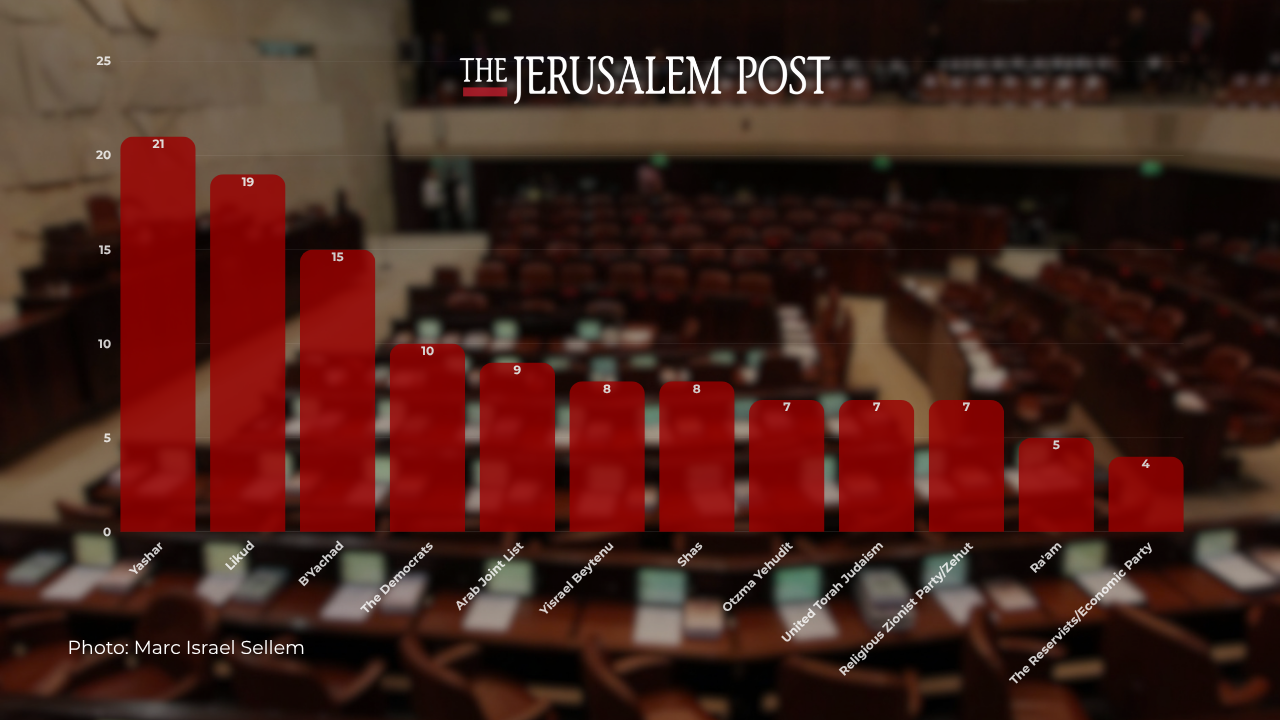
This distribution of seats between the blocs depends on the Reservists-Economic Party crossing the electoral threshold. Given its narrow margin above the threshold in the current poll, if the party fails to qualify, the distribution is expected to shift to 50 seats for the coalition, 56 for the Zionist opposition, and another 14 for the Arab parties.
In addition to People of Israel (3%), the Haredi Public party (0.9%), Noam LeYisrael (0.5%), and Tzomet Beit Yisrael (0.5%) also fail to cross the electoral threshold.
Voter turnout intentions continue to rise
The Maariv poll also found that the proportion of Israelis who are certain they will vote in Tuesday's Knesset election continues to rise, reaching 81%. The figure suggests a potential increase in voter turnout compared with the 2022 election, when turnout stood at 71%.
As in the October 8 poll, the percentage of respondents certain they will vote is higher among opposition party supporters (87%) than among those intending to vote for coalition parties (83%).
Of particular note is the significant increase in the proportion of Arab party supporters who say they are certain to vote, rising from 74% on October 8 to 81% in the current poll, matching the national average.
These figures could result in the Arab party bloc winning significantly more seats in the upcoming election than it holds in the current Knesset. Arab voter turnout has emerged as a significant issue in the election campaign, amid concerns over crime and political distrust in Arab communities.
Eisenkot maintains lead over Netanyahu
The Maariv poll also found that Gadi Eisenkot continues to lead Prime Minister Benjamin Netanyahu in a head-to-head matchup for prime minister, with 49% support compared with Netanyahu's 41%.
Naftali Bennett, who was tied with Netanyahu at 43% in the previous poll, now leads him by 45% to 43%.
Against Avigdor Liberman, Netanyahu continues to lead, although the gap has narrowed slightly, with Netanyahu receiving 44% compared with Liberman's 39%.
Majority of Israelis prefer unity government over new election
As in the previous poll, most Israelis (60%) would prefer a unity government to be formed if the Knesset election produces no clear result.
Of those surveyed, 33% want such a government to be headed by a leader from the change bloc, while 19% want Netanyahu to lead a unity government. Another 8% have no preference regarding who leads it, provided that a unity government is established.
Only 23% would prefer another election in the event of a deadlock, down from 27% in the previous poll. Another 17% said they did not know. A previous Maariv poll published on October 16 also found majority support for a unity government, with 27% preferring another election.
A breakdown of the findings by political bloc shows a decline in the proportion of coalition voters who would prefer another election, from 32% to 25%.
Opposition voters, meanwhile, remain consistent in their preferences, with a majority (55%) favoring a unity government headed by a leader from their own bloc.
The poll was conducted between October 19 and 22 among a representative sample of Israel's population aged 18 and older, including Jewish and Arab respondents. The initial sample consisted of 1,000 participants, while the final sample included 1,048. Data were collected from the general population using Panel4All's online respondent panel. A total of 580 people were contacted, 188 responded (30%), and 78 completed the survey (41%). The researchers also conducted supplementary telephone polling among the Arab population. A total of 687 telephone calls were made, 308 people responded (45%), and 100 completed the survey (32%). The poll's maximum margin of sampling error was 3%.