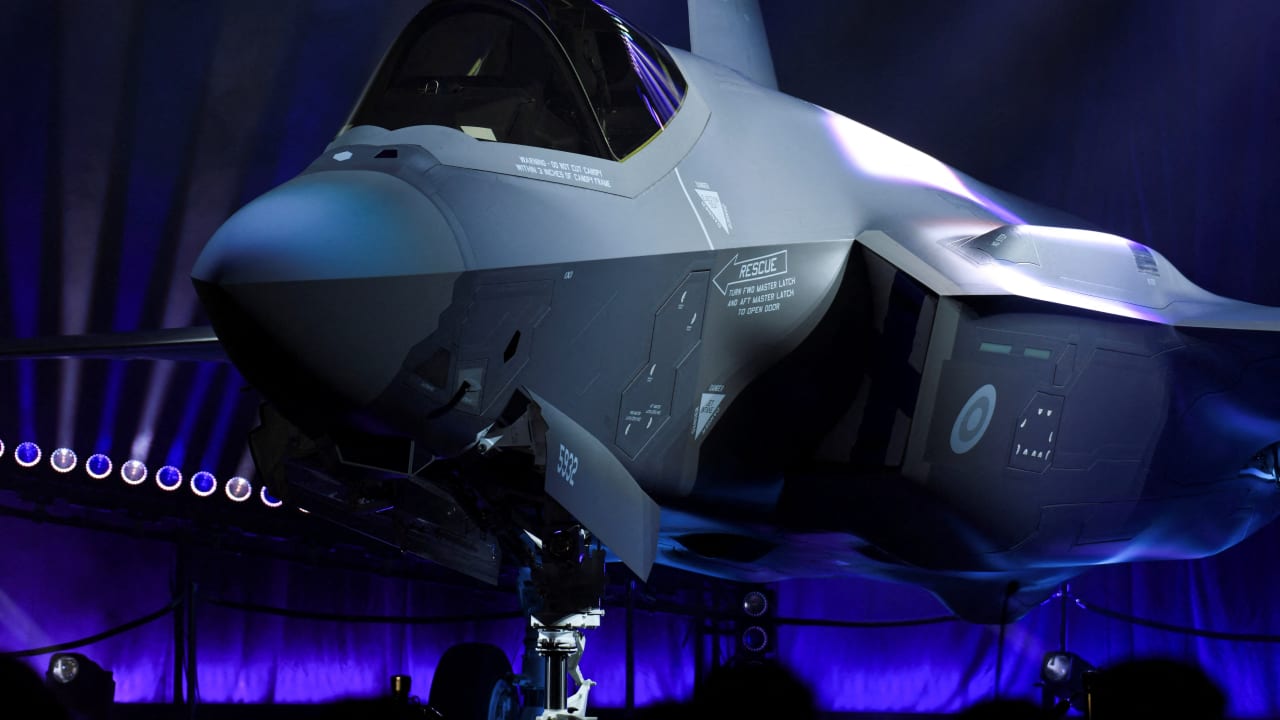
WASHINGTON – Any US sale of F-35 fighter jets to Saudi Arabia should account for Israel’s qualitative military edge and Riyadh’s place in a broader US-led regional security architecture before it moves forward, a Washington national-security expert told The Jerusalem Post following the State Department’s approval of a potential $24.3 billion deal.
Jonathan Ruhe, Fellow for American Strategy at the Jewish Institute for National Security of America (JINSA), said two major issues should be resolved before the kingdom receives the advanced stealth fighters – with Israel’s military edge and regional integration at the top of the list.
“The entire F-35 program is designed to support US-led collective defense,” Ruhe told the Post.
“America must show leadership on integrating Saudi Arabia into a new regional security architecture, and Riyadh also needs to show it’s a committed partner before it can obtain F-35s,” he said. “Israel’s QME is a key factor in this regional integration, and should be reflected in any potential F-35 sale to the kingdom.”
The State Department on Thursday approved a possible Foreign Military Sale to Saudi Arabia of 48 F-35A Lightning II Joint Strike Fighters, 49 Pratt & Whitney F135 engines and related equipment, training and support, with an estimated value of $24.3 billion.

The proposed transaction is not yet a completed contract. The State Department has approved the possible sale, which now moves through the US arms-sale process and congressional review. The State Department said the deal would strengthen Saudi Arabia’s ability to deter threats and improve interoperability with US and allied forces, and maintained that it “will not alter the military balance in the region.”
Israel is currently the only country in the Middle East operating the F-35. US policy on Israel’s qualitative military edge, or QME, is more than a political commitment: Congress wrote the requirement into law in 2008, obligating the US government to consider the effect of major regional arms sales on Israel’s ability to counter credible military threats while minimizing casualties and damage.
For Ruhe, preserving that edge should be part of a broader US effort to integrate Saudi Arabia into a regional defense architecture, rather than be treated simply as a technical question about the capabilities installed on individual aircraft.
China is the second test
The second issue, Ruhe said, concerns Riyadh’s defense and technology relationship with Beijing.
“In exchange for US arms sales and other security cooperation, Washington and Riyadh need an overarching, and overdue, agreement that formally ends worrisome Saudi-Chinese defense and technology ties,” he told the Post.
The New York Times reported Wednesday that US intelligence officials have warned in internal assessments that China could potentially obtain sensitive F-35 technology through espionage in Saudi Arabia or through Beijing’s existing military and security relationships with the kingdom.
A Defense Intelligence Agency assessment examined Chinese access to Saudi military facilities, as well as the kingdom’s use of Chinese telecommunications technology, and raised questions about whether sites housing sensitive F-35 systems could be adequately secured, according to the report. US intelligence analysts have also examined whether Riyadh would agree to restrict contact with Chinese military and intelligence personnel and remove certain Chinese telecommunications equipment from sensitive installations.
Those concerns are not entirely new. Similar worries over Chinese ties played a role in the difficulties surrounding a proposed F-35 sale to the United Arab Emirates following the Abraham Accords.
US enters negotiations with more to offer
Ruhe argued that Washington enters those negotiations with substantial leverage.
“The United States has leverage here, since it can offer Saudi Arabia much more than China can,” he said.
The F-35 is among the most sensitive weapons systems the United States exports, combining stealth, advanced sensors, electronic warfare capabilities and networked combat systems. The proposed Saudi package would also include secure communications and cryptographic equipment, electronic warfare database support, training, simulators, software and logistical support.
Lockheed Martin, based in Fort Worth, Texas, would be the principal aircraft contractor, while Pratt & Whitney would provide the engines.
The China question has therefore become intertwined with the question Ruhe places first: whether introducing the region’s second F-35 operator can strengthen a US-led security system without undermining Israel’s military advantage.
“The potential F-35 sale to Saudi Arabia shouldn’t move forward unless two key issues are first resolved,” Ruhe said.
Jonathan Ruhe is JINSA’s Fellow for American Strategy. He previously worked at the Bipartisan Policy Center, focusing on Middle East and former Soviet Union security issues, and his work has appeared in The Wall Street Journal, The Washington Post, Foreign Policy and The Dispatch.