
Most Israelis know the Mediterranean Sea from a quick dip in its shallow waters. But just beneath the surface, sometimes only a few meters from the shore, lies an underwater world inhabited by creatures few people ever encounter. In recent days, rangers from the Israel Nature and Parks Authority caught a rare glimpse of that world when they spotted dozens of marbled stingrays gathering in shallow waters off Shavei Zion Beach in the Western Galilee.
A rare underwater encounter
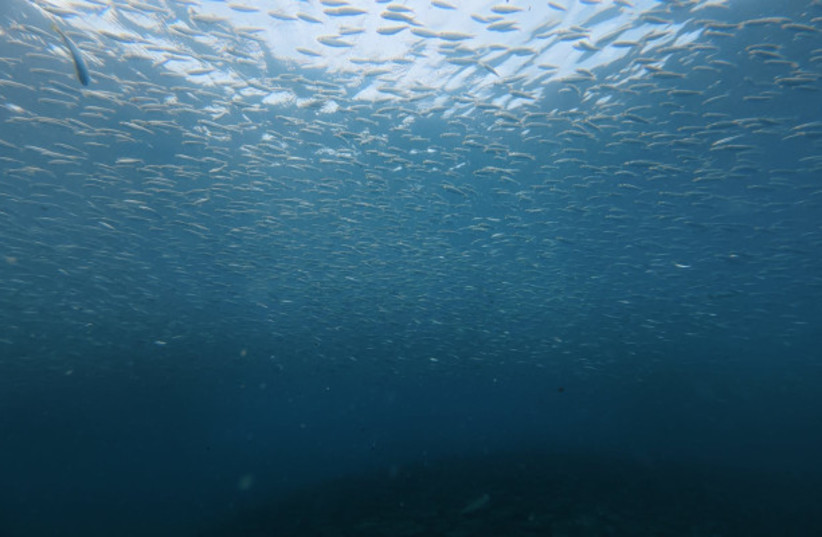
The remarkable scene was discovered by Shay Kabesa and Ziv Neder, rangers with the authority's marine unit, during a routine snorkeling trip to monitor marine life. While observing schools of small fish, the two spotted dozens of rays swimming close to the seabed. They spent an extended period documenting the animals as they moved alongside one another, shifted positions and occasionally clustered together. One ray stood out from the rest, distinguished by its white markings.
"I put my head underwater, and at first I saw mainly schools of small fish," Kabesa said. "I went a little farther, and suddenly, as if someone had lifted a curtain, the seabed came into view, with dozens of rays right beneath me. I floated quietly and didn't want to leave the water."
The marbled stingray is a flat-bodied fish with broad pectoral fins that move like wings. It feeds on animals found on the seabed and in the sand. Like sharks, marbled stingrays belong to the cartilaginous fish group, all members of which are protected in Israel.
Protecting a critically endangered species
According to Dr. Ruth Yahel, head of marine ecology at the Science Division of the Israel Nature and Parks Authority, the marbled stingray is classified by the International Union for Conservation of Nature (IUCN) as endangered globally and critically endangered in the Mediterranean. Unlike fish that lay eggs, marbled stingrays give birth to live young following a gestation period of around six months. They also produce relatively few offspring during each reproductive cycle. "As a result, their populations are particularly vulnerable to harm and struggle to recover from it," she said.
A possible courtship gathering
What brought dozens of rays together in such shallow waters? The authority believes the gathering may have been connected to courtship and reproduction, although more observations are needed to confirm the theory. It is plausible that the gathering was related to reproduction, although further observations are needed to establish this," Dr. Yahel said. "Encountering dozens of individuals in one place highlights the importance of protecting marine habitats."
The authority is urging beachgoers to keep their distance and avoid disturbing the rays. "Anyone coming to observe the rays is asked not to chase them, touch them or try to force their way closer," ranger Ziv Neder said. "Keep your distance and let them decide whether to approach or move away. If this gathering is indeed related to courtship and reproduction, it is especially important not to disturb them."