
Among the most cited stories I ever wrote for The Jerusalem Post was the series of polls taken during US president Barack Obama’s administration asking whether his policies were more pro-Israel or pro-Palestinian.
In June 2019, only 6% of Israelis said they considered Obama more pro-Israel. Two months later, the figure fell to only 4%.
I thought of those polls this week, when Obama made headlines with new false accusations against Israel and current President Donald Trump intervened in next Tuesday’s election by endorsing Prime Minister Benjamin Netanyahu, which he also did when I interviewed the then-businessman for the Post ahead of our election in 2013.
Needless to say, Trump fares far better than Obama here.
A June Pew Research Center poll of 36 countries found that his highest favorability rating is in Israel, at 81%, which is obviously much higher than in the US ahead of the midterm elections there.
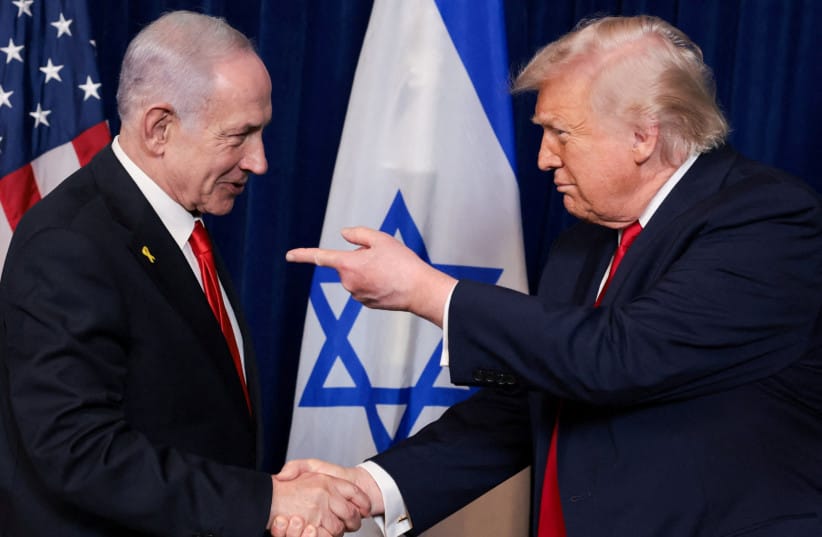
That admiration is not reciprocated, however, considering how our prime minister is perceived in the US.
Americans have little to no confidence in Netanyahu to do the right thing
An April Pew poll found that 59% of Americans have little to no confidence in Netanyahu to do the right thing regarding world affairs, including 76% of Democrats and 44% of Republicans.
A poll taken by the National Opinion Research Center at the University of Chicago in July found that 20% of Americans view Netanyahu favorably, 38% unfavorably, and 41% admit that they do not know enough about him to have an opinion.
Those numbers raise an interesting question ahead of Tuesday’s vote: Would a change in power in Israel significantly impact the perception of the Jewish state in America?
Could we just tell the world that the defeated Netanyahu was responsible for anything they did not like about Israel and that there is no reason to not like us anymore?
The most obvious answer is that no one knows. But that’s no fun, so let’s speculate anyway.
There are historical precedents for a country’s international perception improving dramatically following the departure of a leader who was not liked abroad, and there are historical precedents of it making little difference.
One example of the former is what has happened to Zambia since Hakainde Hichilema replaced Edgar Lungu as president.
Hichilema’s administration initiated major reforms that reshaped how the global community views Zambia, including restructuring the poor country’s debt, restoring press freedom, and broadening public transparency of the work of the government.
An example of the latter is Zimbabwe, following the ouster of long-time authoritarian president Robert Mugabe in 2017.
Mugabe left the country globally isolated as a pariah state due to hyperinflation, intense political violence, and severe human rights abuses. When he was forced to resign following a military intervention in November 2017, the global community felt a brief wave of optimism.
'Zimbabwe is Open for Business'
His successor, Emmerson Mnangagwa, immediately launched an aggressive international public relations campaign.
Using the slogan “Zimbabwe is Open for Business,” Mnangagwa promised a clean break from the autocratic past, pledging to implement democratic reforms, revive the economy, and re-engage with Western nations.
But according to the Council on Foreign Relations, Zimbabwe’s international standing failed to recover because its underlying governance structures remained completely unchanged, which enabled continued human rights abuses and entrenched authoritarianism, resulting in Western sanctions remaining.
No one should compare Israel to Zimbabwe or Netanyahu to Mugabe. But what Netanyahu and Mugabe have in common is that they are their country’s longest-serving leaders who have made plenty of decisions without taking into account how they would be perceived abroad.
AS I POINTED out in my new book, in a 60 Minutes interview five months ago, Netanyahu blamed antisemitism’s resurgence on “a concerted effort by several states to vilify Israel primarily on social media and the standard media, too, and we have not fought back yet.”
“We have not done well on the propaganda war,” Netanyahu said in the interview. “We have to fight back against these lies, this propaganda, with the only weapon we have, which is the truth.”
“I am trying to do that now, and we will try to do that with much greater effort, because we have left the battlefield to our enemies, and boy do they lie – all the time,” he continued.
If Netanyahu keeps that promise and devotes his next government to the narrative war that he himself admits his governments have not engaged in before, perhaps international perception of Israel will improve with him remaining in power.
But for that to happen, he would need to muzzle MKs in his political bloc, who were quoted in an Associated Press piece that ran in The Washington Post this week, titled: “In their own words: Israeli politicians’ extreme speech surges ahead of elections.”
The article features the number two candidate on the Religious Zionist Party and Zehut list, Moshe Feiglin, saying that Gazans “must be expelled by all possible means, such as cutting off their water, and whoever wants to drink a bottle will leave. Killing them all would be incredible.”
Otzma Yehudit’s Yitzhak Kroizer is quoted as saying, “In Jenin, there are no innocent civilians. In Jenin, there are no innocent children.”
And MK Amit Halevi from Netanyahu’s own Likud is quoted about produce from the West Bank, saying, “The bottom line is that the salad you are eating contains a great deal of Palestinian poison.”
The next Knesset could include MKs who care deeply about improving Israel’s public image. I purposely won’t single out a candidate four days before the election, but the forum on Israel’s relationship with the Diaspora hosted this week by the ANU museum (available on YouTube) gives hope.
Maybe too much of the world will hate us no matter who is in the Knesset.
At my election briefing at Shivtei Yisrael synagogue in Ra’anana this week, Australian Jewish leader Danny Lamm, who recently made aliyah, recalled how hard a time he had getting meetings with left-wing leaders for then-Labor Party leader Merav Michaeli when he brought her down under.
And maybe a relationship with the US president matters more than the rest of America.
Trump’s endorsement of Netanyahu was vigorous, and Gadi Eisenkot and his prospective foreign minister Yair Lapid admitted that they tried and failed to persuade the American administration to prevent the endorsement.
The beauty of democracy is that all voters get to decide this big question for themselves if it’s a factor for them when they cast their ballots.
No matter who wins, let’s hope that the polls about Israel and its leadership are better soon – in America and worldwide.■
The writer is the author of The Blood Libel Machine: Exposing the Anti-Israel Hate Network and How to Fight Back, which can be ordered from Amazon or Pomeranzbooks.co.il