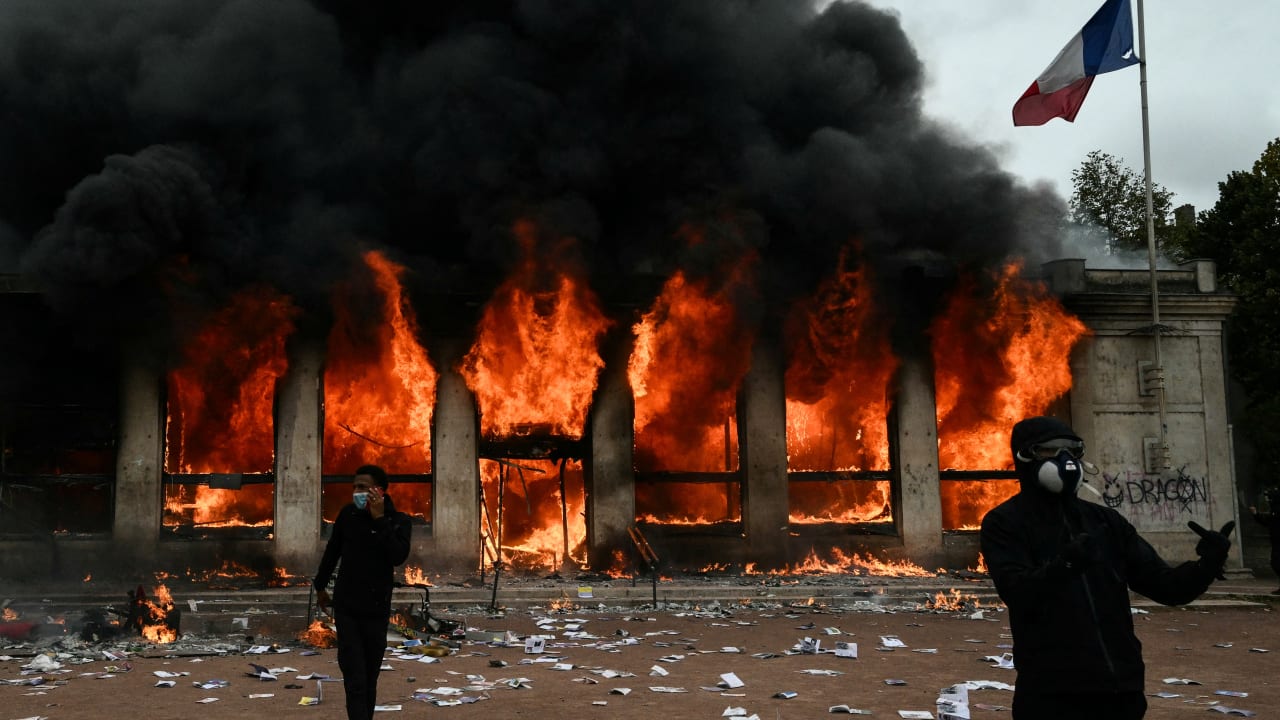
The burning of Limoges Town Hall on October 17 was more than an attack on a government building. It was the destruction of a place woven into the histories of France, Belgium, and the resistance to Nazi occupation.
Built between 1879 and 1883 and inaugurated on July 14, 1883, the town hall was designed by architect Alfred Leclerc. Its architecture blended Renaissance and Louis XIII influences, giving physical form to the ideals of the French Republic. France’s Ministry of Culture recognizes the building as a protected historic monument.
Its importance was not merely architectural.
In May 1940, after Nazi Germany invaded Belgium and King Leopold III surrendered, Belgian ministers and parliamentarians fled to France. Many gathered in Limoges, where the town hall temporarily became a center of Belgian political life in exile. On May 31, Belgian lawmakers met in its ceremonial rooms and condemned the king’s decision to surrender. Belgian flags flew alongside French ones as the displaced government sought to preserve the authority of a country under attack.
During the occupation, the town hall also became a center of resistance activity. Municipal employees altered or sabotaged lists of Jewish residents, hid weapons, issued fraudulent certificates, forged birth records, and created false identity and ration documents. These were not ordinary acts of civil disobedience. They were dangerous efforts to protect Jewish families, resistance fighters, and people attempting to escape forced labor or deportation.

One municipal employee, Suzanne Rodi-Boyer, diverted hundreds of ration cards each month between 1943 and the liberation of Limoges in August 1944. She also obtained official identity documents and used civil records to prepare false papers, including documents for Jewish people in hiding.
That history makes the destruction especially painful. A building once used to resist totalitarianism and help Jews escape persecution has now been badly damaged amid political unrest. According to reports, rioters entered the building after setting fires outside. The flames spread through its ceremonial rooms and into the roof, and the tower collapsed during the blaze.
The attack did not occur in isolation. France has faced demonstrations involving students, unions, political activists, and people angry about education, public services, and the cost of living. Many participants have protested peacefully and raised legitimate grievances. Others have engaged in vandalism, looting, attacks on public buildings, and clashes with police.
French journalist Paul Amar reported that Jewish-owned businesses were also singled out that day on a street in Marseille: “They came prepared. They had the addresses of town halls. They had addresses of Jewish shop owners. In a street in Marseille, all businesses owned by Jews were set on fire. Businesses run by Muslims weren’t.”
Reports that a Paris synagogue was ransacked add a still more disturbing dimension. Images reportedly show religious books and papers scattered across the floor, tefillin unfurled and thrown to the ground, and the holy ark left open. These reports demand a thorough investigation to establish exactly what happened and who was responsible. Any deliberate attack on a synagogue, regardless of the offender’s political identity or stated motive, is an act of antisemitic intimidation and should be condemned without qualification.
The growing visibility of Palestinian flags at demonstrations also deserves honest and serious scrutiny.
Context matters. If demonstrations organized around schools, wages, or living costs become dominated by unrelated geopolitical symbols, people are entitled to ask whether the movement’s message has changed. They may also question whether established political groups are using legitimate social grievances to advance a broader ideological agenda.
The media should investigate those questions rather than dismiss them. Who is organizing the demonstrations? Who is paying for materials and transportation? Which political organizations are recruiting participants? Are extremist groups infiltrating otherwise peaceful marches? When violence occurs, are organizers trying to prevent it, excusing it, or encouraging it?
These are fair questions, and they require evidence-based answers.
What cannot responsibly be claimed, based on Palestinian flags or even shocking acts of vandalism alone, is that there is a proven plan to transform France into a “Sharia colony.” That is an extraordinary allegation. It would require evidence of coordinated leadership, financing, strategy, institutional support, and concrete efforts to replace French constitutional law with Islamic law. The events described here do not, by themselves, establish such a conspiracy. But they do not deny it either.
France's antisemitism problem
France does face real and serious problems: antisemitism, Islamist extremism, political radicalization, social fragmentation, and declining trust in institutions. It also faces far-left and far-right extremism, economic discontent, anger over public services, and a protest culture in which peaceful marches are sometimes hijacked by people seeking confrontation.
Those realities must not be minimized. Nor should they be folded into a single theory without sufficient evidence.
The destruction of Limoges Town Hall and any desecration of a synagogue and destruction of Jewish-owned businesses deserve complete investigations. It cannot be dismissed simply as Far Left activism, as Macron has done. Authorities and journalists should identify the perpetrators, trace organizations involved, publish evidence, and prosecute criminal conduct. The public deserves more than curated video clips, partisan slogans, and vague assurances.
Where is this all going? The public deserves the truth, even if that truth is more complicated than either side wants to admit. If these threats are ignored or distorted for political convenience, Western societies risk losing the institutions, shared values, and civic trust that hold them together.
Dr. Michael J. Salamon is a psychologist specializing in trauma, abuse, and the psychology of terror, and is director of ADC Psychological Services in Netanya and Hewlett, New York.
Louis Libin is an expert in military strategies, wireless innovation, emergency communications, and cybersecurity, and is an adjunct professor at the US War College.