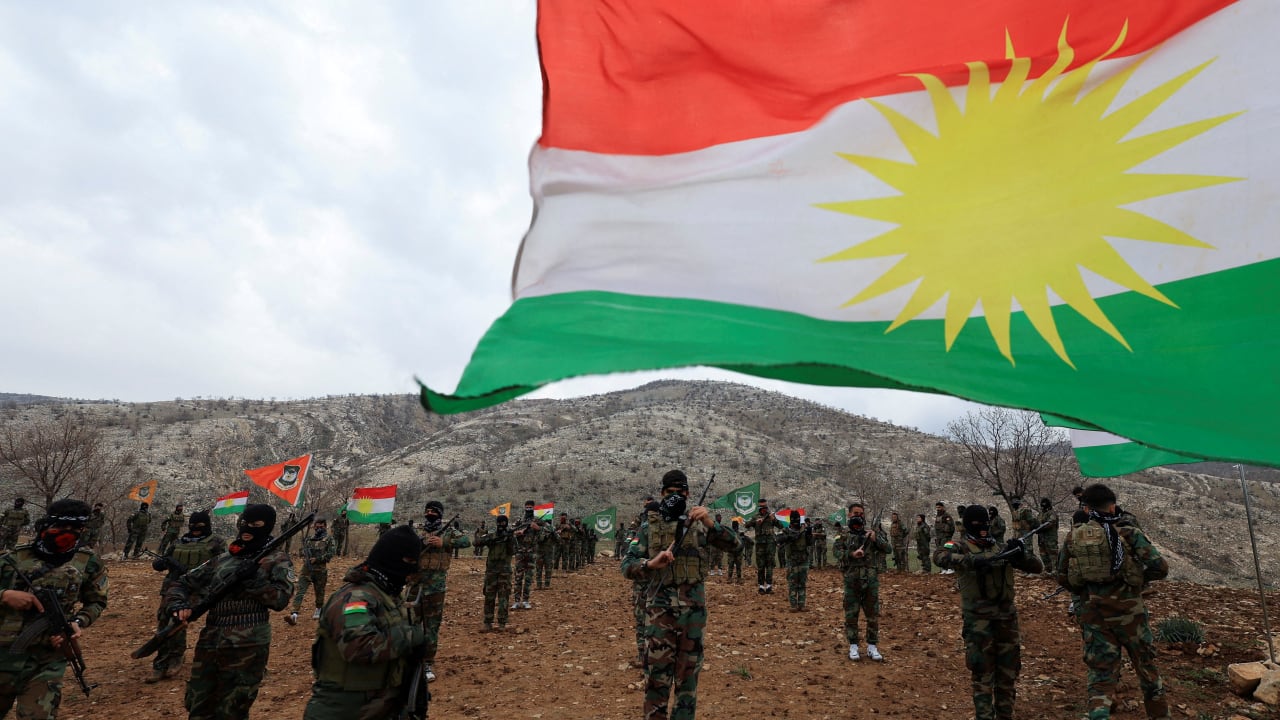
Iran has carried out a drone attack targeting the Kurdistan Regional Government’s (KRG) prime minister’s office. The attack occurred in the early morning hours, with the autonomous KRG government quickly determining that Iran had deployed new jet-powered drones.
The KRG’s Prime Minister, Masrour Barzani, wrote on X/Twitter that “based on information and investigations conducted by the Counter-Terrorism Directorate in the Kurdistan Region, it has been confirmed that my personal office and the residence of the president of the Parastin agency were subjected [on Monday] to Iranian attacks using drones.”
“As I strongly condemn these reckless and unacceptable aggressions in the strongest terms,” he added, “I affirm that they constitute a dangerous escalation and a direct threat to the security and stability of the region.”
“Such attacks will not deter us from continuing to carry out our duties and protecting our citizens,” Barzani said.
The attack came a day after a report at Axios noted that KRG President Nechirvan Barzani was tapped as a possible back channel for diplomacy with Iran.

Nechirvan and Masrour are related, and both come from the Barzani family that runs the Kurdistan Democratic Party (KDP) – the largest Kurdish party in Iraq.
Iran International later confirmed Nechirvan’s role in a report of its own. It is not clear if Iran carried out the drone attack in the context of sending a message to the KRG, or rather, to the US. Apparently, America has been giving the fresh round of talks with Iran the cold shoulder.
The Kurdistan Region has been attacked over 1,000 times by Iran and its proxies since the US and Israeli strikes on Iran in February. Nechirvan Barzani’s residence was targeted in March.
This escalation in attacks, now targeting Masrour Barzani, illustrates how Iran is willing to continue to cross redlines.
Iran is seeking to inflame the region and spread the war to new fronts. Iraq has become a front. Iranian-backed militias attacked Saudi Arabia from Iraq over the last month.
They are pressuring Baghdad to rein in and disarm the militias. However, other disarmament initiatives in Gaza and Lebanon, where Iranian-backed terrorist groups operate, have not been successful so far.
What does the KRG say about the drone attack?
“The Kurdistan Counter-Terrorism Unit has confirmed that at 00:28 on Monday, Iran launched two explosives-laden Hadid 110 drones across the border, targeting the prime minister’s private office (at KRG headquarters) and the home of the head of the KRG Security and Intelligence Agency (in the Pirmam district, Erbil Governorate),” the KRG said.
The Hadid 110 is an Iranian drone that was unveiled in February 2025. It was then supplied to Iran’s Islamic Revolutionary Guard Corps. It is expected to fly faster than piston-driven drones that use propellers.
Further, the Hadid 110 is presumably stealthier than other Iranian drone models. It is not clear how the KRG knew it was this type of drone.
If the use of this drone is confirmed, it would show how Iran is innovating. Tehran has been innovating in drone warfare since the 1980s. In 2020, it sent Shahed 136 drones to the Houthis in Yemen. Until then, this type of delta-wing design had not been widely used.
After it was provided to the Houthis, Iran exported it to Russia, and Moscow has used it extensively against Ukraine. It is possible that the attack on Barzani’s office was a way for Iran to exhibit the drone’s capabilities.
Iran has attacked the Kurdistan Region in the past to use its missiles and drones there as a kind of test bed. The Islamic Republic knows the KRG cannot respond because it lacks defenses.
For instance, Iran used its Fateh 110 missiles in an attack on a Kurdish Iranian opposition group in Koya in the Kurdish region of northern Iraq in 2018. The Islamic Republic then exported drones to Iranian-backed militias in Iraq.
These have been used increasingly since 2022 in attacks in Iran, then in Syria. Saudi Arabia’s Abqaiq power plant was also attacked in this way back in 2019. Iran’s goal was to showcase new drone capabilities.
Iran discloses its warfare tactics against the US
Between 2019 and 2023, Iran raised the curtain on how it would fight the US in a conflict. It spread drone threats all over the region. Kataib Hezbollah, an Iranian-backed militia in Iraq, then attacked Saudi Arabia, as well as US forces in Jordan, in January 2024.
The Iraqi militias also targeted Israel. It is clear that the Iranian threat to the KRG and Barzani is part of this growing war effort by Tehran.
Further, reports indicate that Iran is considering wider, newer actions in the Gulf or against Kuwait. As such, Iran is seeking to be innovative in its threats and attacks. It wants to drive the US from the Gulf and force America to relocate forces further away.
Tehran knows Washington is supposed to leave Iraq on September 30. This may include redeploying from the Kurdistan Region as well.
So far, the US has wrapped up its military operations in Syria. Tehran sees wins on numerous fronts as the US presence changes. It should be recalled that the US also left Afghanistan, which is on the border with Iran.
Although Iran’s Foreign Minister, Abbas Araghchi, appeared to deny the attack on the Kurdistan Region, he went on to claim that it was a “false flag” attack.
Iran wants to muddy the waters through this denial. The goal is to signal to the Kurdistan Region to be careful. Claiming a “false flag” is meant to give Erbil a way to backtrack from any escalation.
Although most countries in the region, such as Saudi Arabia, the UAE, and Qatar, condemned the attack on the Kurdistan Region, most of these countries will not do anything about it.
The US, the UK, and the EU have condemned the attack as well. However, it is unclear whether any country will bolster support for the Kurdistan Region.
As such, although Iran may have crossed a redline, this was intentional – a message meant to demonstrate that it can redraw where those redlines exist across the Middle East.