
‘You can’t always get what you want, but if you try sometimes, well, you just might find, you get what you need,” the Rolling Stones memorably sang almost 60 years ago.
In Israeli politics, however, the Stones’ refrain comes with a catch. The country isn’t getting what it urgently needs – a stable, functioning government – because its politicians are unwilling to give up what they want.
On Tuesday, Gadi Eisenkot’s “change bloc” showed it had the votes to put Matan Kahana in the Knesset speaker’s chair, wresting legislative control away from Prime Minister Benjamin Netanyahu. This is no trifling matter.
For the next number of months, or at least until a new government is sworn in, Israel will effectively have a divided government, with the executive – the government – in the hands of the pro-Netanyahu camp, and the legislature in the hands of the anti-Netanyahu camp.
And the anti-Netanyahu bloc – the change bloc – is wasting no time, using this window to dismantle some of the sitting caretaker government’s core institutional reforms, including some of the judicial reform bills and one dealing with media regulation.
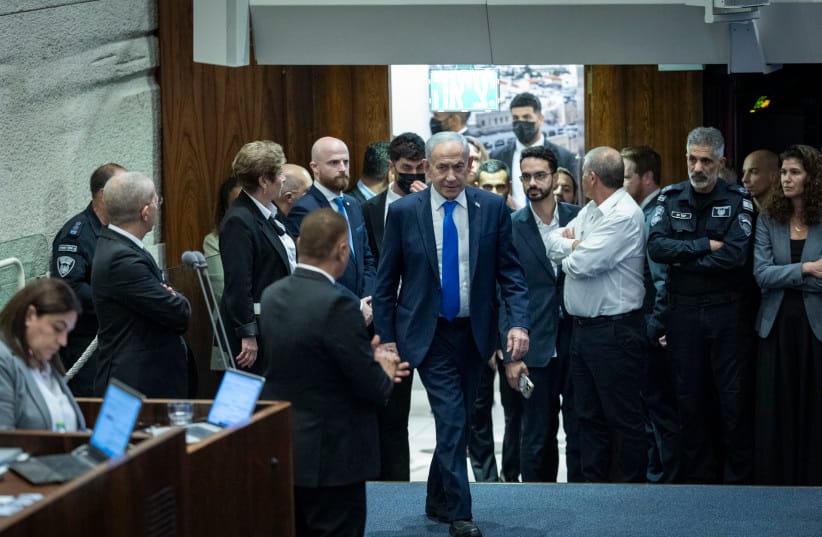
Although Israel was briefly in a similar situation with the legislature in the hands of one party and the government in the hands of another for brief periods during that spiral of elections from 2019 to 2022, it never generated this type of legislative blitz.
Coalition talks stuck
Eisenkot has proven he has the votes to control the legislative levers, and he will use them. But whether he has the votes to put himself in the prime minister’s chair is another question altogether. And the space between having your man in the Knesset speaker’s chair and sitting yourself in the prime minister’s chair is where the coalition talks – soon entering their third week – are stuck.
The change bloc is made up of four parties: Gadi Eisenkot’s Yashar, Naftali Bennett’s B’Yachad, Yair Golan’s Democrats, and Avigdor Liberman’s Yisrael Beytenu. And each is advocating a different direction, or – returning to the Rolling Stones’ song – each wants something. But, in this case, each wants something different.
Bennett, judging from his activity this week – which started with a visit to Likud MK Elisha Medan’s “unity tent,” where he said he believes that “if we can fight together in Gaza, we can work together in this house [the Knesset]” – is leaning hard into the idea of a unity government with the Likud. So hard, in fact, that he met for more than two hours on Wednesday in the Knesset with Netanyahu.
The most logical unity government would be the Likud (27 seats), Eisenkot (21), Bennett (12), and Liberman (7). That gives a solid government of 67.
Why is this the most logical? Because on the major issues – Iran, Gaza, a Palestinian state, security – there is not really that much that separates them. It’s like the difference between red, ruby red, and cherry red.
This would be a government without the haredi parties, without the extremes on the Right and the Left, and without the Arab parties. It could conceivably allow the country, once and for all, to tackle structural issues it has kicked down the road for too long because coalition composition wouldn’t allow agreement: such as haredi conscription and recalibrating the balance of power between the judicial and legislative branches of government.
So why won’t it happen? Because of Netanyahu. It would mean sitting in a government with Netanyahu – something Liberman, whose antipathy toward Netanyahu is boundless, has said he won’t do.
Unity government possible without Liberman
That need not scuttle a unity government, however, since Yisrael Beytenu’s seven seats could be replaced with the four seats of Bezalel Smotrich’s Religious Zionist party, giving such a government 64 seats, though this would give it a slightly more right-wing hue.
There are, of course, some small details that need to be hammered out – such as who would serve as prime minister (Netanyahu has still not publicly uttered the word “rotation”), and who would go first, Netanyahu or Eisenkot.
After Bennett’s meeting with Netanyahu, the B’Yachad leader’s associates stressed he would back a unity rotation government only if Eisenkot goes first – a position echoed in a joint bloc statement later that day calling for an emergency government headed by Eisenkot.
Good luck with that, although that seems to be Bennett’s preferred choice.
The second option is a narrow Eisenkot government supported by the haredi parties – Liberman’s preferred option. This would be a 61-seat government: the 48 change bloc seats plus the 13 from the haredi parties (seven from United Torah Judaism and six from Shas).
This, of course, would mean shelving plans for any bill that would significantly expand haredi conscription. The haredi parties would insist on protecting draft exemptions for yeshiva students as a condition of joining the government.
Liberman, who this week took over temporary chairmanship of the Knesset’s Foreign Affairs and Defense Committee, said that any conscription bill will, in addition to having to satisfy the Supreme Court and the military, also have to satisfy UTJ spiritual leader Rabbi Dov Lando. Judging from previous statements, the only bill that would get Lando’s approval is one that would not draft any yeshiva students, and possibly no haredim at all.
That Liberman is the one pushing this option is stunning.
This is not just a broken campaign promise – like the one Bennett made two days before the 2021 election, when he pledged he would neither make Yair Lapid prime minister nor form a government reliant on Mansour Abbas’s Ra’am. This is something that has been at the core of Liberman’s political identity for more than a decade. This is a completely altered political identity – all because of an unwillingness to sit with Netanyahu.
The last option, support from the Arab parties, is the one preferred by The Democrats’ Yair Golan. He is urging Eisenkot to bring Abbas’s Ra’am into the coalition, giving the change bloc 56 seats against Netanyahu’s 53. The Joint List would then either vote in favor from outside the coalition or abstain in the vote to approve the new government. Either way, a minority government could be sworn in.

While Liberman and Bennett oppose this option – Bennett reportedly told his fellow change-bloc leaders that it would trigger civic unrest that would make the months-long judicial reform protests pale by comparison – Eisenkot, who views removing Netanyahu as prime minister as the most important immediate goal, is not ruling it out.
Former labor minister and coalition negotiator Haim Ramon raised a variation of this theme in a KAN radio interview.
In Ramon’s scenario, Eisenkot turns to his change-bloc partners, who are all pulling in different directions, and tells them he has tried every avenue. A unity government with Eisenkot going first is unrealistic. A deal with the haredim is a nonstarter. Bringing the Arab parties into the coalition is out.
So what’s left? Eisenkot has said innumerable times that the immediate goal is to remove Netanyahu from the prime minister’s chair. If the coalition-building process runs its full course and ends in another election, Netanyahu could still be sitting in that chair as caretaker prime minister when Israelis go back to the polls in late May, and would also remain prime minister as those coalition talks unfold.
It’s worth remembering that during the four elections from 2019 to 2021, Netanyahu served as caretaker prime minister for 19 months. That’s longer, by the way, than Bennett’s and Lapid’s terms in office combined.
Ramon suggested that Eisenkot tell the president he has formed a government and bring it to the Knesset for a vote.
The coalition would consist of the four change-bloc parties and their 48 seats. Give each party three ministers, Ramon said, and leave the longer negotiations, including any renewed talks on unity, until Eisenkot is in the prime minister’s chair.
It’s one thing to negotiate with the haredim when you’re still trying to form a government, Ramon argued. It’s another when you already have one. Plus, once a government is up and running, it may be possible to peel away Likud defectors who don’t want to spend years in the opposition.
But getting that government sworn in is the hard part. Even if the Arab parties remain outside the government, how they vote in the Knesset plenum would determine whether a 48-seat minority cabinet can prevail against Netanyahu’s 53-seat bloc. Both Bennett and Liberman have vowed to oppose any government that depends on Arab-party support. By bringing the government to a vote, Eisenkot would effectively dare them to block it – triggering a high-stakes game of political chicken.
Would they stick to their pledge if it meant keeping Netanyahu in the prime minister’s chair, an outcome both have described in the recent past as nothing less than a clear and present danger? Or would they vote with Eisenkot to turn Netanyahu out of office, even if that meant the government would be voted in on the strength of the Arab parties’ votes?
And so Mick Jagger’s famous lyric plays out a little differently in Jerusalem. Bennett wants unity. Liberman wants a deal with the haredim. Golan wants to work with the Arab parties. Eisenkot wants Netanyahu out by whatever arithmetic works. And Netanyahu wants to stay put while his rivals joust and come up empty-handed.
Until some of them give ground on what they want, Israel will go without what it so urgently needs: a stable, workable government.