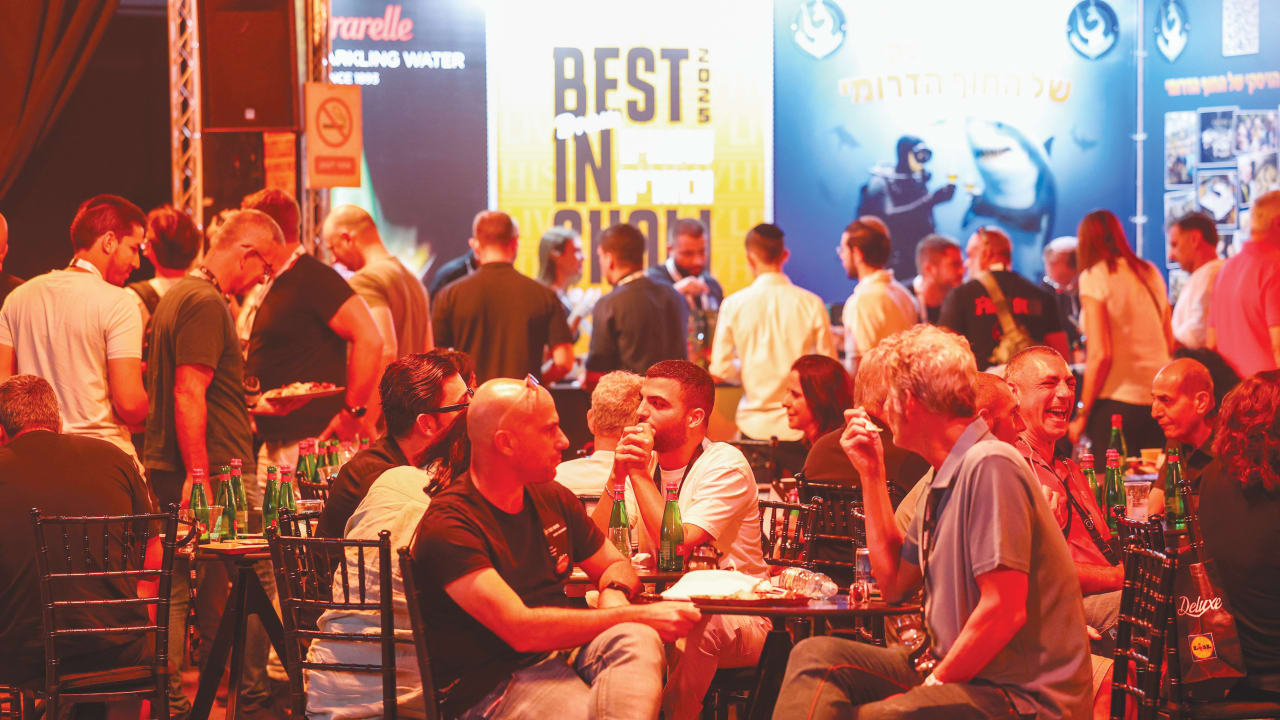
Keeping any cultural venture going for long in this state budget-strapped country is quite an achievement, so it’s hats off to the Whisky Live bunch.
Actually, raising a glass of some amber nectar, rather than tipping some headgear, might be more to the point, as the country’s distilleries, a bunch of their professional counterparts from Scotland, and local market players get together next week for the 12th edition of the Israeli industry’s Whisky Live at Expo Tel Aviv (September 2-3).
The gathering is an opportunity for like-minded, if not like-palated, folks to convene, mingle, slurp, consider, lounge around, and simply share their love for a beverage that has been around for at least eight centuries.
The earliest records of alcohol distillation date to 13th-century Italy, when monasteries used the process primarily for medicinal purposes, including the treatment of colic and smallpox.
The first mention of whisky – or whiskey, as it is spelled in Ireland and the United States – comes from the Annals of Clonmacnoise, a 17th-century document that documents goings-on in Ireland from the early 15th century. There is a description of the death of a chieftain in 1405 due to “taking a surfeit of aqua vitae” at Christmas.

Aqua vitae, “water of life” in Latin, subsequently evolved into uisce betha in Middle Irish and uisge beatha in Scottish Gaelic.
Early forms of the word in English, from the 16th century through to the 18th century, included the baffling-looking “uskebeaghe,” “usquebaugh,” “usquebath,” and “usquebae,” the first part of all of which sounds very much like the present “whisk(e)y.”
So much for the etymological backdrop, but whisky is, first and foremost, about the taste, as well as a keen appreciation of the aroma and beguiling hues.
Whisky Live Israel features workshops courtesy of Irish, Scottish distilleries
Visitors to Whisky Live Israel – one of 30-plus such affairs that take place around the world – will, no doubt, soak up the ambiance of the occasion, as the alcohol vapors eddy through the dense, humid Tel Aviv afternoon and evening air, before getting into the business end activity of the event and lubricating their gullets with some quality, intriguing swigs.
They stand to get more for their entrance fee than just highly stimulated taste buds and a few hours of milling around in a convivial atmosphere.
The two-day program features a string of workshops courtesy of the likes of the Teeling distillery near Dublin and the Singleton distillery of Scotland.
Fergus Simpson will also be around to impart some of the professional wisdom he has accrued over the years, currently in the employ of the Duncan Taylor Scotch Whisky company, located in Huntly, in the far northeast of Scotland.
Duncan Taylor is a renowned independent bottling enterprise founded in Glasgow almost 90 years ago. As the company’s global ambassador, Simpson regularly crisscrosses the world to proffer tastings and thematic master classes.
The genial septuagenarian former teacher is looking forward to his foray over here, and had some kind words for our whisky-making efforts in this troubled spot in the Middle East.
“Whisky, today, is made all over the world,” he observes. “You’ve got [Israeli industry leader] Milk & Honey with [distiller] Tomer [Goren]. Some of the stuff he does is very nice. And there’s Japan, which makes good whisky, and there are good European whiskies, say in France and Sweden.
“Germany, for example, now has more whisky distilleries than Scotland,” he notes. Now that was a surprise. Mind you, it seems quantity does not necessarily translate into quality. “Most of them are pretty small, and some of them are not very good,” he chuckles.
Indeed, this Start-Up Nation of ours appears to be gaining ground in yet another field. I recall purchasing a bottle of Israeli whisky not long after the scene began here, around 10 years ago. It was pretty poor. But not that many years down the road, our distilleries can joust with the best of them.
Simpson is not surprised it took some time before we got our whisky-making act together. “It takes a while to get the equipment right, to get the processes right. But that’s what you have to do.”
Producing quality alcohol, particularly whisky, is a tricky business. Thankfully, there’s no AI fast-tracking route to a quality bottom line, at least to date. Perhaps there’s something special in the air, the water, the streams, and soil there north of the English border.
“We’ve just had the experience of years and years of doing it,” Simpson puts it simply. The proof of the pudding, or the beverage, is right there to be sampled. “You go to a distillery, and they say, ‘This is how we do it.’ Then you ask why, and they say ‘Well, we’ve done that since we opened in 1823’ or whatever,” Simpson laughs. And it works, he may have added.
The craft of whisky making comes across as a delicate balancing act between art, intuition, and science. The latter, says Simpson, is playing an ever-growing part in the process, even as the folks in his native land, often scions of a long line of whisky makers, continue to feed off the rich local heritage.
“The science, now, is a lot better, compared with 50 years ago. There’s a lot more scientific knowledge and research about things. And there’s the experience of doing it.”
The global ambassador invokes the aforementioned street-level triad. “You need all three [of art, intuition, and science]. Science is more and more important. A lot of distilleries now are completely computerized, so the distillery worker now just presses buttons.”
That, to my romantic technophobic-leaning mind, sounds anathema to the idea of whisky being the beloved end product of decades, if not centuries, of tried-and-tested knowledge passed down from father to son, as one generation entrusts secret recipes, accrued experiential wisdom, and evolving pertinent DNA to the next.
Simpson, with his long timeline in the field, is well positioned to consider the advantages and disadvantages of the hi-tech school of thought and the traditionalist, more Mother Nature-aligned approach.
“That’s okay,” he generously suggests, referencing the streamlined, computer-controlled process take.
But there is a price to pay for the hands-off production route. “What it means is the quality of the whisky, shall we say, is in a narrower range. You never get the really awful casks, like you used to get 50 years ago. But it’s really difficult to get the really stellar ones now, because it’s in a narrower range.”
That, naturally, suits the profit-and-loss-sheet-conscious ethos. “For most of the big companies, that’s all they want. They want standard, standard, standard. The big whisky companies are not single malt companies. They’re blended companies. For them the malts are just raw ingredients.”
Not that Simpson is an out-and-out single malt snob. “There’s nothing wrong with blends. There’s Chivas Regal. Some of the Chivas Regal blends are very, very good. And it’s an art. The art of blending is producing something that’s good.”
Simpson’s own employer is in on the fusion game, too. “We’ve got our own premium blend called Black Bull. That’s great whisky.”
Simpson also enlightened me about the company’s modus operandi, as a bottler. “We don’t have a distillery, and we never have. We source whisky, mature it, and when we think it’s ready we bottle it.”
The fact that Duncan Taylor isn’t involved at the very outset of the process does not mean it can’t guide the process toward a specific product objective. That is largely down to the hardware.
“We have a lot of control. We’re perhaps the only independent bottler in Scotland with our own cooperage, to maintain and look after the quality of the casks.”
One cannot overstate the significance of that to the whisky quality and direction.
“The cask is king,” Simpson declares, adding that most of Duncan Taylor’s offerings are single cask whiskies.
“If you’ve got a poor-quality cask and good-quality spirit, you’ll end up with bad whisky. You need a good cask and good spirit to have a good bottle. That’s very, very important.
“We control absolutely everything. We can take in new spirit, put it into our casks and set it down for aging; and when it’s ready, it’s ready. If it’s not good, we won’t bottle it. It’s whisky without compromise.”
Notwithstanding the enormous leaps in technological apparatus in recent years, that is very much down to professional human judgment.
“There’s no scientific thing. How long does it take? Well, it takes as long as it’s ready. That’s it,” Simpson chortles. “You can’t just put it on a spreadsheet and say, right, it’ll be ready in five years’ time; in five years’ time, it will be this. That’s not how things work.”
Presumably, over time, Simpson has honed his senses in a way that technologically driven devices have yet to achieve, with the accent very much on “yet.”
Then again, one can wax lyrical as much as one wants about this or that attribute of their chosen tipple. But when push comes to shove, what any whisky consumer really wants is a flavorful drinking experience when he or she settles down in their favorite armchair at the end of a hard day at the office, or in the company of people close to them – with an alcohol appreciation common denominator.
“There are lots of things about a whisky, but the most important thing is the taste, what it’s like in your mouth, in your palate. Any whisky drinker can find themselves in a position whereby they’ve smelled the whisky in the glass, and they think this is going to be wonderful. But when he tastes it, he may find it’s not quite as good as they expected. What a shame,” Simpson laughs a little wryly.
Apparently, it can work the other way, too. “Sometimes you can smell a whisky, and you think it’s just about average, but when it’s on your palate you think wow, what a delight.”
Simpson is a professional with a no-nonsense take on his line of work and the fluid bottom line.
“Whisky is for drinking,” he intones with full gravitas.
Even though prices of spirits around the world have risen appreciably over the last decade or so, Simpson says you don’t have to fork out loads of cash in order to wrap your palate around a decent whisky. “We’ve got whiskies that cost a lot, but $60 will also get you a pretty decent whisky.”
And some are available here, including from the Octave range, which runs through to bottles that will set you back thousands of dollars. But, as Simpson puts it in somewhat more mundane terms, if you’ve got the wherewithal to own a Ferrari, why not drive it rather than keeping it in the garage.
Tomer Goren, head distiller at M&H (aka Milk and Honey), Israel’s first whisky distillery, also organizes Whisky Live. As such, he has a hands-on overview of the way the local scene is panning out.
The first glaring difference that sticks out between Simpson’s home patch and ours is, of course, the weather. When I spoke to the Scot in the run-up to the annual event here, it was a scarcely believable 16 degrees Celsius in his neck of the woods in northeast Scotland. That has to influence the way Israeli distillers approach their craft.
“We have a hot, humid climate in most of the country. That gives you an accelerated maturation process,” Goren notes.
Is that a boon? “You have to know how to work with that. It is not just an advantage. You have to know how to obviate over-aging.”
He says it is early days to talk about Israeli whisky as having a distinct character of its own. “The industry here has only been around 12 or 13 years.”
That is not just a matter of chronology. “We have eight distilleries in Israel, and each one makes a different style of whisky.”
True to the pioneering spirit, which appears to be endemic to this still-young country’s makeup, local distillers have a knack for innovation, says Goren. “We always think outside the box. We know how to innovate, and we are good at learning. At the end of the day, we are proving ourselves. We have some excellent distilleries here.”
Despite Goren’s caution that imbibing alcohol is fine and dandy, as long as it is done in a responsible manner, I wondered whether our continually trying circumstances here have any effect on Israeli drinking predilection.
“Absolutely,” comes the resounding confirmation. “We, for example, collaborated with people from Kibbutz Be’eri. We struck up a warm friendship with them, after we hosted them just three months after that October 7. Their visit helped them to relax a bit, forget for a while, and open up.”
That sounds like one tasty way to get a breather from the trauma and intensity of life in this part of the world. Cheers.
For more information about Whisky Live Israel: https://go-out.co/event/1776076451546